Poem a Week: False Clover (Oxalis) by Beth Winegarner

Don't even think about wishing on
my green hearts. They fold
like the wings of three butterflies,
heads in a huddle. Never four,
not like the one you think I am
when you spy me under
the redwoods' emerald umbrella.

They don't call me sour grass
for nothing. In the wood I am sorrel,
a word like a mouthful of spring;
at home I choke your tender
peas and parsley for all I'm worth.
With each drift of yellow petals
I'm building up my buttercup brigade.

Go on. Pull me. I like it so much I
shower seeds so I can do it again.
Smother me with your thickest mulch;
I will dig my way into the sunlight.
Purge is another name for propagate.
When you found me, you were right
on one count: I can change your luck.

Poem a Week: Basket Stinkhorn by Beth Winegarner

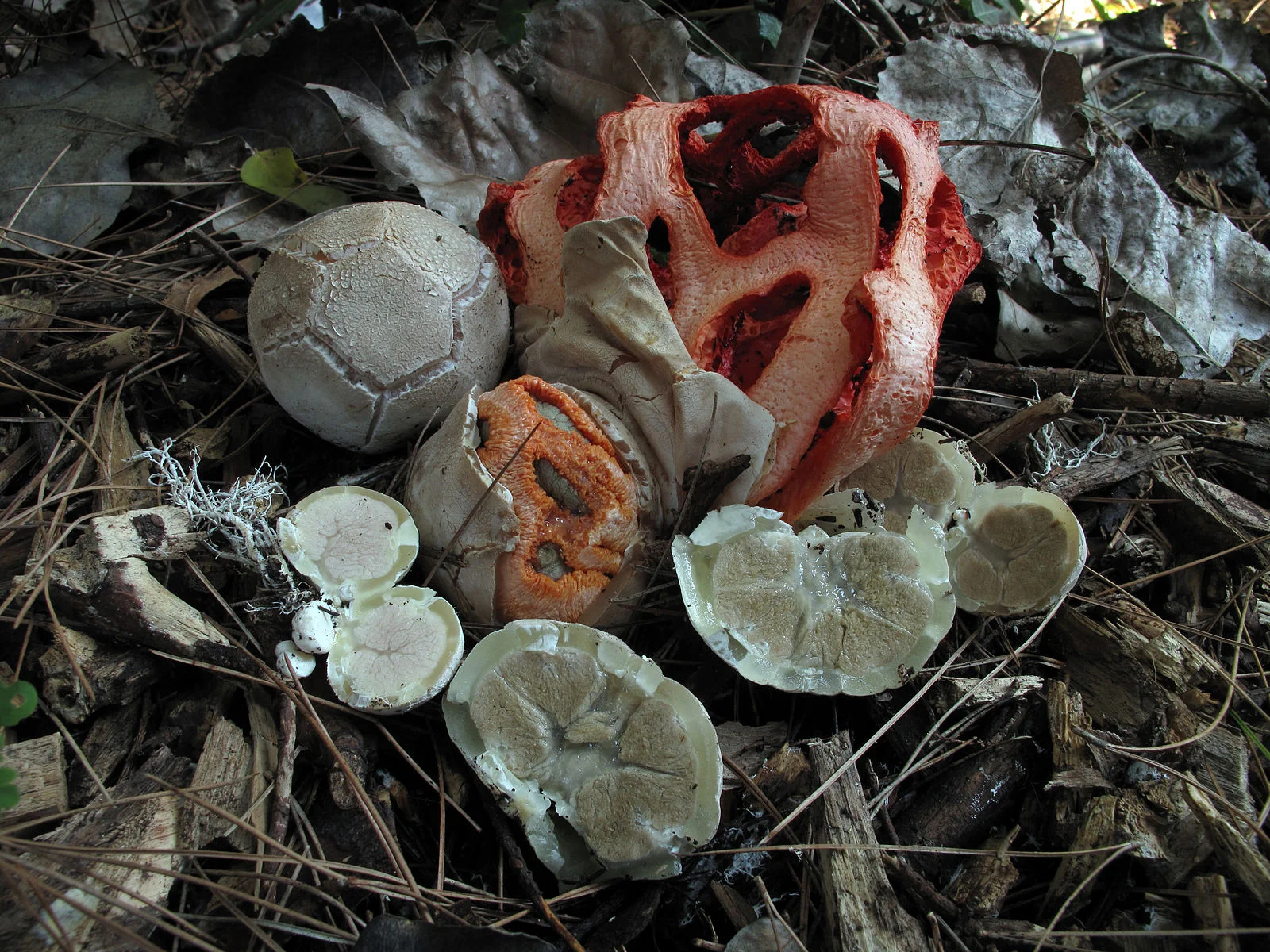
Several basket stinkhorn mushrooms, Clathrus ruber, at varying stages of development.

Several basket stinkhorn mushrooms, Clathrus ruber, at varying stages of development.

Alien egg, or bee-spun globe
the size of a toddler's head
sleeping in its bed
of sedums and mud.

At first no more than a marshmallow,
round and mute as an amnion.
Inside, a fungus fossil blooms
a basket of brains.

Come closer, whiff the perfume
of putrescence, a dead ringer
for summer-baked carrion.
You'll catch more flies

with stench than maple syrup
and this is no waffle worth eating.
Stand aside. Let the insects
scatter saprobes as they soar.

Poem a Week: Land's End by Beth Winegarner

The Golden Gate Bridge as seen from the Land’s End trail. Photo by Pest15.

The Golden Gate Bridge as seen from the Land’s End trail. Photo by Pest15.

Land’s End

This trail has everything:
views of the Pacific so full, the horizon scythes.
Squawking ravens. Foghorn.
Wide tableau of the fog-headed bridge.
Warning signs that keep you from learning the hard way
about fragile cliffs, sleeper waves, poison oak.

The Great Beach is never
more than a stone's throw from the Great Highway.
There is no getting lost here,
only nature half-tamed
as walking cliches in track suits
check their cell phones for signal.

Even the gulls crave McDonald's.
Even the surf knows Natalie Wood.
Here, you could dismiss the sea's cold limbs,
crumbling headlands, toxic perennials,
and, beyond the water, a green land so feral
it makes you forget you are part of it.

Poem a Week: Furniture by Beth Winegarner

Screen Shot 2019-10-26 at 10.31.29 AM.png

I am sitting on the couch. The baby
is resting against my arm as though
I'm her personal BarcaLounger, and the kitty
is curled up on my knee. The baby
is taking lazy draws from her bottle while idly
clutching handfuls of the kitty's
ears and scruff, which the kitty tolerates because
it's the closest thing she may get
to petting for some hours. I think
she may even be purring. All three
of us are relaxed, in our own minds,
afternoon daze. I wonder what life is like
in their small, wordless heads,
what they wonder about my large noisiness
and long limbs. We're neither Plath's
fat gold watch nor Cassatt's beatitudes,
but somewhere in between,
furniture for one another. 

(2009)

Of Craneflies and Kitties by Beth Winegarner

Screen Shot 2019-04-18 at 3.21.28 PM.png

It’s cranefly season here in Northern California, and they seem to be everywhere. They bounce against the siding on the back of our house like they’re rappelling down a sheer rock face. They rest in the shade, hiding under windowsills. They mate for hours at a time, motionless on the doorframe or flying awkwardly across the yard.

When I come in from the backyard they dart through the opening in the door; you can almost hear the “woohoo!” as they swoop in. But then they sulk around the house, perching near the tops of walls, waiting for mates that are, generally speaking, outside. They resist efforts to shoo them back to the open air.

One made it all the way across the house into the living room, where it hung around the lamps in the evening and divebombed my head, landing on my shirt and tickling my chin before ambling off again. But it made the mistake one afternoon of flying close to the floor. Our cat, Pigeon, chased it around the room, chittering at it, and managed to trap it under her front paws. She opened her mouth and took it in, but somehow it got away. How does that even happen?

The cranefly escaped to the mantel, where it hid and caught its breath, so to speak. Pigeon had managed to injure one of its legs, which was leaking white goo. A few minutes later the cranefly braved a journey across the room, but this time it had a long trail of dusty spiderweb stuck to its gooey leg, weighing it down. Pigeon caught it again and made a few smacking sounds with her mouth. I haven’t seen the cranefly since.

Pigeon, as you may have guessed by now, is not a skilled hunter, even of bugs. (Last week I caught her bothering, but failing to catch, a fly that only had one wing.) She’s also really scared of cars -- to the extent that she won’t go near the front of our house, especially if she can see out the windows, because the sights and sounds of cars going by terrify her.

Today, though, the street was quiet, aside from a couple of workmen, and she got curious. She crouched on the ottoman by the window and carefully raised her head enough so that she could see outside. As she spied the workmen, her ears perked up and her tail twitched attentively. But a moment later, a car sped by, and Pigeon turned and bolted from the room.

She’s smart to be scared of cars, but I was impressed at her bravery. She knows she can’t tolerate the cars outside, but she tested herself anyway, going to the window and peeking out, letting her curiosity override her fear for a moment.

How to love your double chin by Beth Winegarner

A Galápagos sea lion. Photo courtesy Wikimedia Commons.

A Galápagos sea lion. Photo courtesy Wikimedia Commons.

I was sitting at a bus stop at the corner of 40th and Telegraph in Oakland a few months ago when an older man sat down next to me. He was slender, wearing fitted black trousers and a slightly oversized sweater of the sort that Dwayne Wayne might have worn on A Different World. His dark face was etched with deep lines.

He started telling me, his voice thick with southern twang, about his latest trip to Kaiser to get the dressing changed on a wound — from what, he didn’t say. It had taken too long and he’d been given the runaround and he had to go back tomorrow to do it all over again. I nodded and smiled, and said a few encouraging words here and there. He was pleasant enough.

He paused in his story to look at me, then pointed to my double chin. “You should get that jelly roll looked at,” he said, hoisting himself up as the bus drew near. “That can mean all sorts of trouble.”

My enjoyment of the banter evaporated, replaced with shame as a hot flush spread across my face and my stomach turned to stone.

I’m plus-sized. Zaftig. Curvy. Chubby. Voluptuous. Fat. For each of us, body fat settles in different spots. Our asses. Our thighs. Our arms. In my case, it’s mostly my belly. And my chin. Even when I was at my thinnest, I still had a roundness under my jaw. When I look at other plus-sized folks, I notice that the ones I find most beautiful are the ones with sharp jawlines. No “jelly rolls” underneath.

And yet, I don’t like feeling hatred or disgust toward a part of my body. “There’s good reason we’re afraid of our double chins,” fat activist and author Virgie Tovar wrote last fall. “We live in a culture that is openly hateful toward fat people. Friends, family and social media reward us for appearing as close to the (thin) standard as possible in photographs. I understand the impetus completely.”

Tovar moved past these feelings by embracing photos of herself taken from low angles that accentuated her double chin — or at least no longer hid it. I’m nowhere near that point yet, but last year I found myself opening up a Google search window and typing “how to love your double chin.”

Google assumed I’d made a typo. “Did you mean ‘how to lose your double chin?’” Pages of search results related to cosmetic surgery, jaw exercises or weird nighttime contraptions followed.

Great. Even the search engines were fatphobic.

I showed the results to my partner, D., who works at Google, though not in the search-engine department. We tested the results again in an incognito window to make sure Google was showing this “correction” to others as well, and it was.

Google has internal forms that allow employees to report when they notice something is awry; those reports do make their way to the right teams, sooner or later. A few months later, D. checked the search query again and realized Google was no longer spell-correcting the phrase, and was offering better results in the links. The body-positive ones are still mixed in with exercise videos and other body-shamery, but it’s better than it was.

Screen Shot 2019-03-18 at 11.58.33 AM.png

I still struggle with loving this part of myself (despite how delicious a jelly roll is). But at least I contributed to something that will make it easier for other people to love theirs.


Of "Cherokee Maidens" and "Native American DNA" by Beth Winegarner

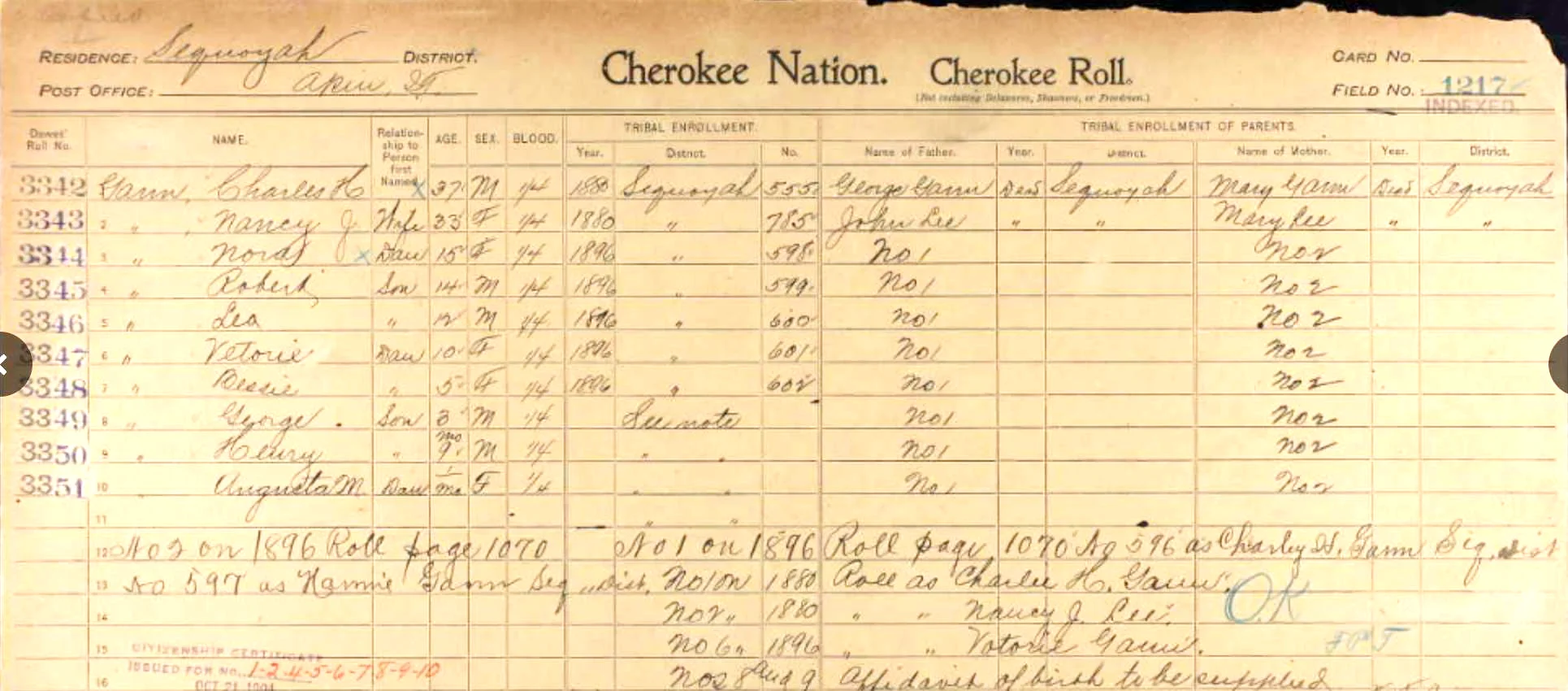
Gann-cherokee.jpg

My mom grew up in Georgia, and her family — the Joneses, the Jacksons, the Purcells, the Bourns, the Ganns and so on — lived in Georgia and the Carolinas for generations.

Like many folks with roots in the South, I grew up hearing that I had some Cherokee ancestry. Not just Native American ancestry, but Cherokee specifically. Given what I knew about the history of Georgia — and the history of Tsalagi (Cherokee) tribespeople intermarrying with European settlers, it didn’t seem all that far-fetched.

More embarrassingly, though, I repeated the information as though it were true. I told people I was “part Cherokee.” I burned sage to “cleanse” places of “bad energy” and I hung a dreamcatcher by my bed. I read badly romanticized books on supposedly indigenous American shamanic practices written by white people and imagined that path for myself. More helpfully, I read books about the history of genocide against Native Americans in the Americas, the occupation of Alcatraz in the year I was born, the uprising and resistance at Wounded Knee, and similar protests.

I watched Thunderheart. Over and over and over.

When I gained access to my family history, both through genealogy records and DNA testing, I discovered very quickly that a) I didn’t have any “Native American DNA,” (a misleading description, any way you look at it) and b) that there was indeed an “Indian princess” in my tree, a title which was most certainly a fiction.

My 6th great-grandmother, Elizabeth Eastin, is listed in many an online family tree as a “Cherokee maiden” or “Indian princess,” but there’s no documentation to support the claim. Records do show that she existed, that she married my 6th great-grandfather, Nathan Gann, and that she was born in Halifax County (it’s unclear if this was in Virginia or South Carolina) in 1745 and died in Oconee County, Georgia, in 1803.

Gregory D. Smithers writes:

According to the work of Vine Deloria, one of NCAI’s leading intellectuals, “Cherokee was the most popular tribe” in America. “From Maine to Washington State,” Deloria recalled, white Americans insisted they were descended from Cherokee ancestors. More often than not, that ancestor was an “Indian princess,” despite the fact that the tribe never had a social system with anything resembling an inherited title like “princess.”

While researching my family history, I discovered that there is a Facebook group for Gann descendants who are looking at their genealogy. Although a lot of us have this “Cherokee maiden” in our family trees, our DNA suggests otherwise. Granted, that might be because any indigenous DNA is just too far back to be detectable. But, without documentation to suggest otherwise, it’s safer and more respectful to assume the ancestry just isn’t there.

If you look at the image at the top of this post, it’s a snapshot of a branch of the Gann family who registered with the Cherokee Nation rolls in 1896. There’s Charles Gann, who was likely 100% European, his wife, Nancy, who was likely Tsalagi, and their children. These kids and their descendants, regardless of DNA, can claim Tsalagi ancestry. I’m not a direct descendant of Charles and Nancy, but their descendants are out there. Not everyone who intermarried with the Tsalagi registered on the Cherokee rolls, though, so an absence of this document isn’t definitive one way or another.

Smithers again:

So why have so many Americans laid claim to a clearly fictional identity? … The Cherokees resisted state and federal efforts to remove them from their Southeastern homelands during the 1820s and 1830s. During that time, most whites saw them as an inconvenient nuisance, an obstacle to colonial expansion. But after their removal, the tribe came to be viewed more romantically, especially in the antebellum South, where its determination to maintain rights of self-government against the federal government took on new meaning. Throughout the South in the 1840s and 1850s, large numbers of whites began claiming they were descended from a Cherokee great-grandmother. That great-grandmother was often a “princess,” a not-inconsequential detail in a region obsessed with social status and suspicious of outsiders. By claiming a royal Cherokee ancestor, white Southerners were legitimating the antiquity of their native-born status as sons or daughters of the South, as well as establishing their determination to defend their rights against an aggressive federal government, as they imagined the Cherokees had done. These may have been self-serving historical delusions, but they have proven to be enduring.

In response to Sen. Elizabeth Warren’s problematic use of Native American identity, Cherokee Nation Cherokee Nation Secretary of State Chuck Hoskin Jr. said in a statement that using "a DNA test to lay claim to any connection to the Cherokee Nation or any tribal nation, even vaguely, is inappropriate and wrong." 

At the end of the day, DNA is not the same as ancestry, and ancestry is not the same as tribal or other cultural affiliation — let alone belonging. It’s important not to throw such ancestry claims around casually. Reconstructing a family tree is fun and rewarding work that helps us better understand not only where we come from, but the histories our ancestors lived — even when those histories were unimaginably hard, or shamefully cruel.

The sensory thrill of heavy metal by Beth Winegarner

A mosh pit. Photo by dr_zoidberg. Creative Commons license.

A mosh pit. Photo by dr_zoidberg. Creative Commons license.

When I first got into heavy metal as a teenager, I was surprised by how calm and happy it made me feel. It was just after the peak of the moral panic around heavy metal, in which conservative religious groups — as well as the Parents Music Resource Center, headed by Al Gore’s wife, Tipper — convinced much of the U.S. that heavy metal was evil, that it led teenagers into violent and risky behavior, or tempted them toward the occult. Part of me came to believe that nonsense, too, but when I began to listen to the music, my nervous system said otherwise.

I wanna feel the wind in my face
And the velvet shimmering limousines
Like a kiss from the queen of the damned
Like the smell of gasoline

It wasn’t until much later, when I read Jeffrey Jensen Arnett’s book Metalheads, that I learned this calming effect was common. I knew plenty of other metalheads myself, but our response to the music wasn’t something we talked a lot about. Arnett wrote:

Adolescent boys who are high in sensation seeking tend to be attracted to heavy metal music and also tend to have higher rates of reckless behavior, because both heavy metal music and reckless behavior provide intense and novel sensations. … Enjoyment of heavy metal music and enjoyment of reckless behavior tend to be found in the same boys, not because heavy metal music causes reckless behavior but because both experiences reflect an enjoyment of intense and novel sensations.

(It should be noted that Arnett, when he researched these questions, spoke mostly with young, white, male metal fans. His finding likely extends to a lot of white female metalheads, but it would be speculation to go beyond that. I’m not sure anyone has replicated his research among girls and women, people of color, trans and queer folks, etc., but they should.)

I am, in most circumstances, quite sensitive to sounds — especially loud sounds, whether they’re high and sharp or low and rumbling. (As I write this, a car with a bad muffler is idling outside my house and it’s really stressing me out — but I will happily listen to drone/doom bands that make not-dissimilar sounds. Go figure.) I spend a fair bit of time explaining to people how I can be so sensitive to noise but adore heavy metal which, to mainstream ears, is the definition of noise. But it’s organized sound, I tell them, with a steady rhythm of bass and drums, structured around repeating patterns of riffs, often infused with a lot of gorgeous melody and grandeur. It’s exactly the right kind of noise.

Black leather and glittering steel
They're calling me back, so I'm turning my head to the wheel
Black leather and glittering steel
I'm thirsty for more, so I'm sending my foot to the floor

Although kids and adults on the autism spectrum are known for being sensitive to sensations — tags and seams in clothing, food textures, visual clutter — we all have sensations we avoid, or seek. Maybe it’s the feel of velvet or silk, tight jeans or a loose, faded flannel shirt. Maybe it’s the sweet bite of whiskey, a pull on a cigarette, riding a motorcycle at 70 miles per hour on the freeway, swimming as the water hugs you, the pressure in your joints when you do yardwork, or the rhythm of a rocking chair. Maybe it’s the swirl of the mosh pit, knocking into your comrades, crowd-surfing to the edge of the stage.

I was listening to Riot’s song “Black Metal and Glittering Steel” this morning (lyrics quoted throughout this post) and realized that it’s essentially an ode to sensation, to the sensory-seeking lives of those metalheads Arnett interviewed way back in the early 1990s. Riot were masters of speed metal, and “Black Leather…,” although it only clocks in at 85 bpm, feels much faster, thanks to its fast riffing and high-energy vocals. The lyrics talk about the feel of speeding, the smell of gasoline, the sight of shimmering limousines, the taste of a kiss — it’s pure sensation, in song form.

"It's a vicarious release of aggression," one subject told Arnett, and he said he needed heavy metal as a release: "Otherwise I'd lose control." "It calms me down," said several others; "it helps me get things out," said another, explaining that he was referring to the stress accumulated from school, disagreements with parents, and so on. One described it as "like taking a tranquilizer."

It still kills me that, for at least a generation, parents were taking their kids’ metal records away, scared that the music would make them violent or evil. If anything, listening to music led kids to engage in less risky behavior, because they had a safer outlet at hand. That sounds like a prescription for more heavy metal, not less.

Gender, Occult Writing, and a Project that Fell Apart by Beth Winegarner

Image credit: Katherine Hanlon.

Image credit: Katherine Hanlon.

About a dozen years ago, two friends of mine and I had the idea to edit an anthology of essays by women occultists. We’d heard so many stories of skilled, knowledgable women going to OTO meetings or other occult gatherings, only to be asked if they were there with a husband or boyfriend or treated like clueless newbies.

Many of the most revered occult texts were written by men: Aleister Crowley, A.O. Spare, Israel Regardie, Eliphas Levi, etc. Even modern-day occult book publishing was largely dominated by men: Peter Carroll, Lon Milo DuQuette, Phil Hine, etc. Sure, there were a few women here and there, notably Dion Fortune and Helena Blavatsky. And there are more these days. But still, not enough to create balance.

My co-editors and I were part of a larger occult community at the time, and we knew women who were inventing their own approaches, spellcraft and systems of magic. We wanted them to get their due. We wanted to help them to claim the spotlight. We wanted their work to be known, followed, practiced. And we wanted the wider occult world to know that women were working just as hard on this stuff as men.

We began by inviting some of our favorite female occultists — ones who had been at it a long time, who were smart and serious, and who were good writers — to write essays for us. These would be the ones we’d use to sell the book project to a publisher before putting out a wider call for submissions.

The responses, in many ways, revealed a great deal about why more women weren’t getting published in this area. A few did offer to contribute, but most said they couldn’t, at least not at the time we were asking. They were taking care of young children or aging parents. Their work took up almost all of their time. They were buried under other projects and couldn’t take more on. It’s possible that this was their kind way of saying no to something they didn’t want to be part of. But it also speaks to the kind of lives women have — filled to the brim with interpersonal obligations, emotional labor and maybe a touch of imposter syndrome.

At that point, my co-editors and I began talking about a change in direction for the project, and we couldn’t agree on the new direction. It fell apart, largely for that reason.

I do wish we’d been able to pull it off, although I see now that we should have been much more inclusive in our approach, seeking work not only from women but from trans, genderqueer and nonbinary folks in the occult world.

I haven’t been involved in occult communities in a long time and I can’t speak to whether they’ve become more balanced and less misogynistic, but I’d be (happily!) surprised if they had. If you’re a scholar of the occult, what good books have you read in the past dozen years written by nonbinary, genderqueer, trans or female occultists?

Things I remind myself by Beth Winegarner

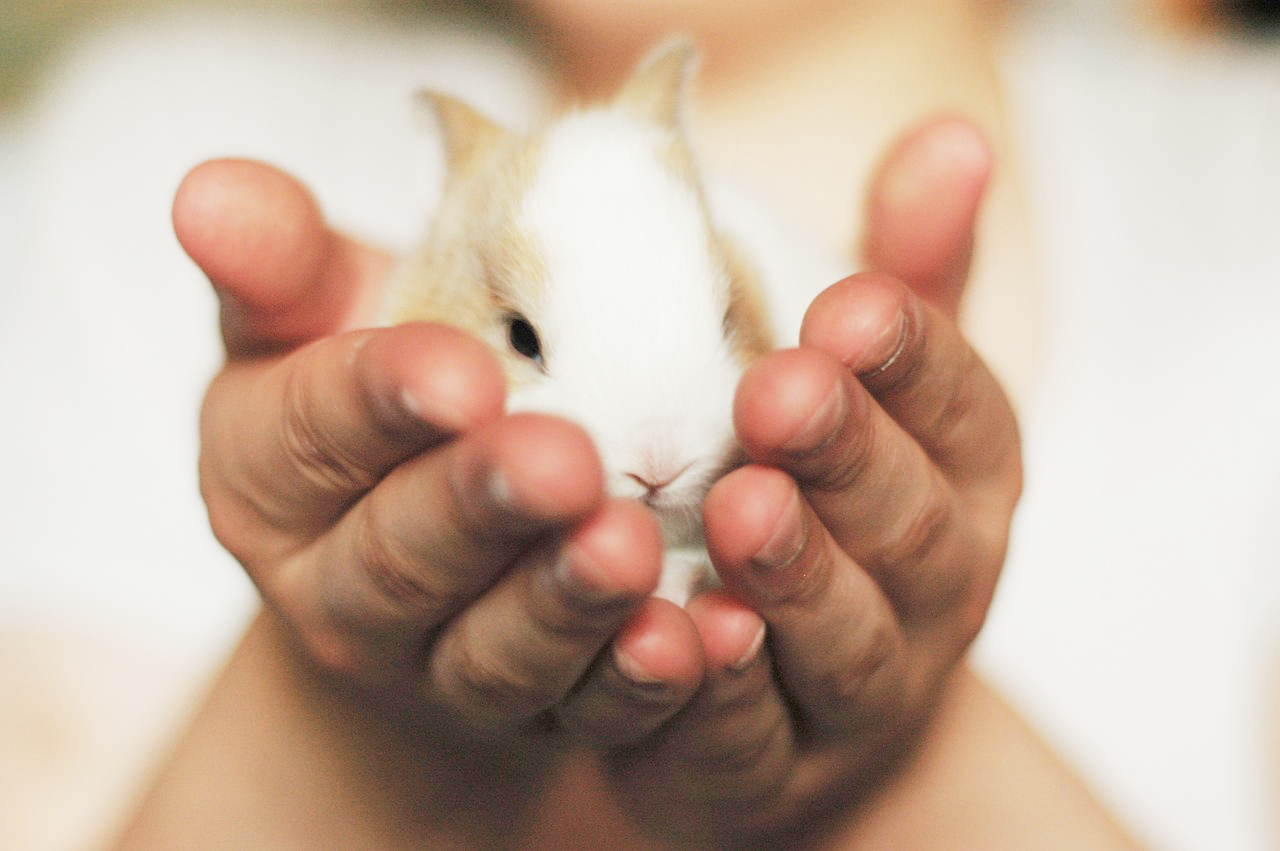
rabbit-2742525_1280.jpg

When I want to feel more compassion for those around me, I remind myself that inside us all are small children walking around in our big, grownup bodies, and we don’t always know what to do. Sometimes we all wish an adult would show up and show us the way.

When I want to feel more compassion for those around me, I remind myself that inside our human brain is a mammal brain whose only function is feeling, and inside that is a reptile brain that keeps us alive and tries to keep us out of danger. Sometimes the mammal or the reptile brain is in control.

When I want to feel more compassion for those around me, I remind myself that all of us are dealing with hidden struggles, some of them very deep and serious.

[Hokusai] says every one of us is a child,
every one of us is ancient,
every one of us has a body.
He says every one of us is frightened.
He says every one of us has to find a way to live with fear.
— Roger Keys