Poem A Week: Juggernaut by Beth Winegarner

Photo by Pablo Heimplatz. Creative Commons.

Photo by Pablo Heimplatz. Creative Commons.

For 14 years I carried
Two heavy globes of meat,
No toothsome peaches or
Swelling melons, no jugs
Of sweet milk or brass rings
You could knock to be let in. 

Unrelenting dogs followed me, 
Wet-jawed and hungry, hunting
Strong meat in weak flesh, 
Blind to the birds in the trees
Or fields of titmice, noses only
For the boar in the thicket. 

The weight split my spine,
Tore my muscles, hacked my head
To shards. I festered in darkness
And saw stars, wept while
Hardy vines cut furrows
Into my inadequate shoulders. 

So I lay on Anubis' slab, 
That head of all jackals, 
Made a deal: I gave him eight
Pounds of flesh, he called
The dogs from my shadow.
I would never see his kind again. 

Now my rosebuds bend lightly
Within the green vale, small
Matters swelling with the need 
To feed tiny mouths, invisible
To the flesh-starved animals
Whose jaws now slaver elsewhere. 

Poem A Week: Thallium Thrum by Beth Winegarner

Photo by AndriyKo Podilnyk. Creative Commons.

Photo by AndriyKo Podilnyk. Creative Commons.

What were the woods like on the day you arrived?
Did the moon throw its silver down upon the breast of the clearing,
betting which of you would be fairer and brighter?
Did the redwoods, steaming in the summer night, hold their breath
so their next lungful would be spiked with your newborn scent?
Did all the fantastic animals -- the basilisks and cockatrices,
sphinxes and griffins -- spread their wings wide over the smoky loam
and wait for the new beast to join their ranks?
(Did the Blemmys purse his belly’s lips and bend down to kiss
the soft crown of your hour-old head, dusted with gold silk?)
Did the low creek wish it were full and rushing, spilling its banks
strong enough to carry you in your cradle
like the captain of a wicker-woven ship speeding toward the sea?
Did the scuttling insects of the deep earth construct
a tiny castle and wait for their cochineal king to take his throne?
None of these, more likely;
but the blazing July sun, which learned its light from your eyes,
would have understood if the night had stepped aside
to make way for your foot’s first fall.

Poem A Week: The Silver Cord by Beth Winegarner

Photo by novi raj. Creative Commons.

Photo by novi raj. Creative Commons.

There's a thin filament line
Taut, silver and fine.
At one end is me, today,
And the other stretches back in time.

I know the one on the other end,
That girl I was at fifteen,
At sixteen, at twenty,
That girl always feeling so full. And so empty.

If I tug on the cord I can sense her resist.
But she is the one who pulls the line,
Baiting me and winding me in,
Reeling me back to her time.

An age of damp woods and rainfall
Of secret scents and low guitars
Where the boys stretch up like branches
And she loves, oh she devours them all.

She will not grow, she will not forget,
She will not die.
And sometimes her wound is so dark and wide
That I cannot, cannot hide.

She pulls the moss sack over my head,
And she presses his sweet lips to mine,
And I remember my thirst for his kisses,
His water, his salt, his wine.

Her high song rings in the valleys,
So loud she cannot hear my warning.
She does not want to hear my warning:
She will lose him when her mother dies.

And from that earthy hillside grave,
The woods will darken,
And the songs will fade.
And all that he was will be unmade.

And all that she was will be unmade.

The People My Ancestors Enslaved by Beth Winegarner

rsz_1cotton.jpg

Blacks who are descended from enslaved people face unfair challenges when they try to trace their ancestry. It wasn’t until the 1870 census, in the United States, that many enslaved black Americans were counted as free people, and by their first and last names. Before that, the genealogical path becomes one of piecing together the 1860 and 1850 slave schedules and the wills or sale receipts of their enslavers, who may have listed them only by first name and age. 

Much of my maternal line came over from Western Europe and settled in the Southern part of the U.S. by the early 1700s, and almost every branch includes one or more enslavers. I’ve done my best to document these enslavers, and the people they enslaved, in the hope that it might make the road easier for their descendants, hoping to find out more about where and who they came from. 

The information in this post is everything I have been able to find, to date, on these people, but please reach out if you have questions. 

For more help researching enslaved ancestors, I highly recommend the Facebook group I’ve Traced my Enslaved Ancestors and their Owners.


The names of the following enslaved people are listed in this document:

Adaline (John Gann will, 1858, Clarke County, Georgia)
Alexander (Thomas Gillespie will, 1838, Rowan County, North Carolina)
Alice (Thomas Gillespie will, 1838, Rowan County, North Carolina)
Ami (John Gann will, 1858, Clarke County, Georgia)
Anderson (baby; unclear if this is a first or last name) (William Gann will, 1852, Clarke County, Georgia)
Ann (Isaac Bradley will, 1848, Greenville County, South Carolina)
Betsey (Amos Banks will, 1843, Lexington County, South Carolina)
Caroline  (Ignatius Nathan Gann will, 1854, Dallas, Paulding County, Georgia)
Cato (Thomas Kimbrough will, 1777, Caswell County, North Carolina)
Caty (Thomas Gillespie will, 1838, Rowan County, North Carolina)
Ceeser (Thomas Gillespie will, 1838, Rowan County, North Carolina)
Chaney Gann (Ignatius Nathan Gann will, 1854, Dallas, Paulding County, Georgia)
Charity (John Gann will, 1858, Clarke County, Georgia)
Charlotte (Thomas Gillespie will, 1838, Rowan County, North Carolina)
Ciciro (John Gann will, 1858, Clarke County, Georgia)
Clary (Abraham Bradley will, 1823, Greenville County, South Carolina)
David (Thomas Gillespie will, 1838, Rowan County, North Carolina)
Dick (Mary Polly Thomas will, St. Peters, Pennsylvania)
Elic  (Ignatius Nathan Gann will, 1854, Dallas, Paulding County, Georgia)
Emeline (Thomas Gillespie will, 1838, Rowan County, North Carolina)
Emily (Isaac Bradley will, 1848, Greenville County, South Carolina)
Emily  (Ignatius Nathan Gann will, 1854, Dallas, Paulding County, Georgia)
Esther (George Long will, 1815, South Carolina)
Flora (Thomas Gillespie will, 1838, Rowan County, North Carolina)
Frank (John Gann will, 1858, Clarke County, Georgia)
Gabe (Thomas Kimbrough will, 1777, Caswell County, North Carolina)
George  (Ignatius Nathan Gann will, 1854, Dallas, Paulding County, Georgia)
George (John Gann will, 1858, Clarke County, Georgia)
George (Thomas Kimbrough will, 1777, Caswell County, North Carolina)
Hannah (Jeremiah Jackson will, 1825, Greene County, Georgia)
Harry (Jeremiah Jackson will, 1825, Greene County, Georgia)
Hegor (woman) (Mary Polly Thomas will, St. Peters, Pennsylvania)
Henry (Isaac Bradley will, 1848, Greenville County, South Carolina)
Henry (John Gann will, 1858, Clarke County, Georgia)
Henry (Ignatius Nathan Gann will, 1854, Dallas, Paulding County, Georgia)
Isaac (Thomas Gillespie will, 1838, Rowan County, North Carolina)
Isaac  (Ignatius Nathan Gann will, 1854, Dallas, Paulding County, Georgia)
Jane (John Gann will, 1858, Clarke County, Georgia)
Jenny (Thomas Kimbrough will, 1777, Caswell County, North Carolina)
Jesse (Thomas Gillespie will, 1838, Rowan County, North Carolina)
Jim (Isaac Bradley will, 1848, Greenville County, South Carolina)
Jim (John Gann will, 1858, Clarke County, Georgia)
Joe  (Ignatius Nathan Gann will, 1854, Dallas, Paulding County, Georgia)
John (William Gann will, 1852, Clarke County, Georgia)
Jude (girl) (William Kimbrough will, 1803, Greene County, Georgia)
Julia (William Gann will, 1852, Clarke County, Georgia)
Kezia (Isaac Bradley will, 1848, Greenville County, South Carolina)
Lewis  (Ignatius Nathan Gann will, 1854, Dallas, Paulding County, Georgia)
Lewis (John Gann will, 1858, Clarke County, Georgia)
Linda  (Ignatius Nathan Gann will, 1854, Dallas, Paulding County, Georgia)
Lucy (William Gann will, 1852, Clarke County, Georgia)
Lucy (Ignatius Nathan Gann will, 1854, Dallas, Paulding County, Georgia)
Lydden (Thomas Kimbrough will, 1777, Caswell County, North Carolina)
Margaret (Thomas Gillespie will, 1838, Rowan County, North Carolina)
Martha (John Gann will, 1858, Clarke County, Georgia)
Mary Gann (Ignatius Nathan Gann will, 1854, Dallas, Paulding County, Georgia)
Micah (John Gann will, 1858, Clarke County, Georgia)
Milly  (Ignatius Nathan Gann will, 1854, Dallas, Paulding County, Georgia)
Mimi (William Kimbrough will, 1803, Greene County, Georgia)
Mira (George Long will, 1815, South Carolina)
Monica (Isaac Bradley will, 1848, Greenville County, South Carolina)
Ned (Ignatius Nathan Gann will, 1854, Dallas, Paulding County, Georgia)
Nancy (Thomas Gillespie will, 1838, Rowan County, North Carolina)
Oliver  (Ignatius Nathan Gann will, 1854, Dallas, Paulding County, Georgia)
Parker (Thomas Gillespie will, 1838, Rowan County, North Carolina)
Patience  (Ignatius Nathan Gann will, 1854, Dallas, Paulding County, Georgia)
Peter (Jeremiah Jackson will, 1825, Greene County, Georgia)
Peter (John Gann will, 1858, Clarke County, Georgia)
Phebee (Thomas Kimbrough will, 1777, Caswell County, North Carolina)
Polly (Amos Banks will, 1843, Lexington County, South Carolina)
Rachel (Thomas Gillespie will, 1838, Rowan County, North Carolina)
Rebeckah (Thomas Gillespie will, 1838, Rowan County, North Carolina)
Ritty/Rithy (Thomas Gillespie will, 1838, Rowan County, North Carolina)
Sam (George Long will, 1815, South Carolina)
Sam (Thomas Gillespie will, 1838, Rowan County, North Carolina)
Sam (Thomas Kimbrough will, 1777, Caswell County, North Carolina)
Sandy (Thomas Gillespie will, 1838, Rowan County, North Carolina)
Sarah (George Long will, 1815, South Carolina)
Serlla (John Gann will, 1858, Clarke County, Georgia)
Silas (Thomas Gillespie will, 1838, Rowan County, North Carolina)
Silvey (William Kimbrough will, 1803, Greene County, Georgia)
Solomon  (Ignatius Nathan Gann will, 1854, Dallas, Paulding County, Georgia)
Suiey (Thomas Kimbrough will, 1777, Caswell County, North Carolina)
Susanah (Amos Banks will, 1843, Lexington County, South Carolina)
Thomas (Thomas Gillespie will, 1838, Rowan County, North Carolina)
Tom (a blacksmith): sold by Amos Banks to Michael Long on May 23, 1843, Edgefield, South Carolina
Tom (William Gann will, 1852, Clarke County, Georgia)
Vilda (Ignatius Nathan Gann will, 1854, Dallas, Paulding County, Georgia)
William (William Gann will, 1852, Clarke County, Georgia)
Willis  (Ignatius Nathan Gann will, 1854, Dallas, Paulding County, Georgia)


Listed in this document are the following enslavers. Details are below: 

Amos Banks, 1777-1843, Lexington County, South Carolina
Charles Banks, 1747-1830, Charleston, South Carolina
Abraham Bradley, 1737-1823, Greenville County, South Carolina
Isaac Bradley, 1785-1847, Greenville County, South Carolina
Daniel Ashley Bruce, 1807-1891, Greenville County, South Carolina
John T. Frey, 1802-1854, Lexington County, South Carolina
Henry “Granser” Gann, 1816-1914, Clarke County, Georgia
Ignatius Nathan Gann, 1785-1854, Clarke County, Georgia
John Gann, Sr., 1770-1856, Clarke County, Georgia
Nathan Gann III, 1821-1900, Paulding County, Georgia
William Gann, 1794-1853, Clarke County, Georgia
Malachi Green, 1790-1879, Martin County, North Carolina
Thomas Gillespie, 1770-1838, Abbeville County, South Carolina, and Gordon County, Georgia
Daniel E. Jackson, 1796-1869, DeKalb County, Georgia
Jeremiah Jackson, 1760-1828, Greene County, Georgia
John H. Jones, 1802-1886, DeKalb County, Georgia
Thomas Kimbrough, 1690-1777, Caswell County, North Carolina
William Kimbrough, 1735-1803, Caswell County North Carolina
George Long, 1758-1815, Edgefield, North Carolina
Hugh McLin, 1749-1843, Abbeville County, North Carolina
John Henry Segars, 1733-1806, Wake County, North Carolina and Darlington County, South Carolina
John Summers, 1762-1848, Hillsboro, North Carolina and Clarke County, Georgia
Mary Polly Thomas, 1694-1771, Chester County, Pennsylvania


My fifth great-grandfather, Amos Banks, was born May 11, 1777 in Lexington, South Carolina and died February 6, 1843 in Lexington, South Carolina.

  • In the 1820 census, he is listed as enslaving one person, a man between the ages of 26 and 44 in Lexington, South Carolina.

  • In the 1830 census, he is listed as enslaving 13 people: one boy between the ages of 10 and 23, three men between the ages of 24 and 35, two men between the ages of 36 and 54, one girl under 10, two girls between the ages of 10 and 23, two women between the ages of 24 and 35, and two women between the ages of 36 and 54, in Lexington, South Carolina. 

  • In the 1840 census, he is listed as enslaving 11 people: two boys under age 10, two boys between the ages of 10 and 23, two men between 24 and 35, one man between 36 and 54, one girl under 10, one girl between 10 and 23, one woman between 24 and 35, and one woman between 36 and 54, in Edgefield, South Carolina.

The March, 1843, slave records say that Amos Banks sold a black man named Tom, a blacksmith, to Michael Long for $375. The sale took place in Edgefield, South Carolina, on May 23, 1843. Michael Long was likely the brother of Amos Banks’ wife, Catherine. 

In his 1843 will, Amos Banks left his wife, Catherine (maiden name Long), “one negro girl named Polly,” and his son, Thomas, “consideration of two negroes, Susanah and Betsey, which I sold to Drury Fort.”


My sixth great-grandfather, Charles Banks, Jr. was born June 10, 1747, in Prince George, Virginia, and died January 26, 1830, in Lexington County, South Carolina. He was the father of Amos Banks. 

  • In the 1800 census, he is listed as enslaving 7 people in Charleston, South Carolina. 

  • In the 1810 census, he is listed as enslaving 9 people in Charleston, South Carolina.

  • In the 1820 census, he is listed as enslaving 7 people in Charleston, South Carolina.

  • In the 1830 census, he is listed as enslaving 2 girls between 10 and 23 years of age, two women between 24 and 35 years of age, and one boy under age 10. 


My sixth great-grandfather, Abraham Bradley, was born in 1737 in Orange County, Virginia and died on October 23, 1823, in Greenville, South Carolina. He was the father of Isaac Bradley.

  • In the 1790 census, he is listed as enslaving one person in Greenville, South Carolina. 

  • In the 1800 census, he is listed as enslaving 4 people in Greenville, South Carolina.

  • In the 1810 census, he is listed as enslaving 8 people in Greenville, South Carolina.

  • In the 1820 census, he is listed as enslaving 4 people: one boy under 14, two men between the ages of 26 and 44, and one woman 45 or older, in Greenville, South Carolina.

In his 1823 will, he left his wife, Sarah Elizabeth Bradley (maiden name Lane), “one negro girl named Clary and a child.”


My fifth great-grandfather, Isaac Bradley, was born in 1785 in Orange, North Carolina and died in 1847 in Greenville, South Carolina. He was the son of Abraham Bradley, listed above. 

  • In the 1820 census, he is listed as enslaving one person, a boy between age 14 and 25, in Greenville, South Carolina.

  • In the 1830 census, he is listed as enslaving one person, a boy between age 10 and 23, in Greenville, South Carolina. 

  • In the 1840 census, he is listed as enslaving three people, two girls under 10 and one girl between 10 and 23, in Greenville, South Carolina. 

In his 1848 will, he left his wife, Sarah Armstrong (my fifth great-grandmother), two girls named Emily and Monica. He left Daniel Bruce (his son-in-law, and my fourth great-grandfather) a girl named Ann. He left James McAdams a woman named Kezia and her child (no name recorded). To TJ Dean he left a boy named Jim, and to ES Irvine he left a boy named Henry. 


My fourth great-grandfather, Daniel Ashley Bruce, was born March 3, 1807, in Wolfcreek, Pendleton County, South Carolina and died in 1891 in Greenville County, South Carolina. He served in the Confederate Army. 

In the 1850 slave schedule, he is listed as enslaving a 5-year-old girl. This may be Ann, the girl he inherited from his father-in-law, Isaac Bradley, listed above. 


My fourth great-grandfather, John T. Frey, was born October 2, 1802, in Lexington, South Carolina, and died June 27, 1854, in Lexington, South Carolina.

In the 1840 census, he is listed as owning one slave, a man between age 24 and 35, in Lexington, South Carolina. 


My fourth great-grandfather, Malachi Green, was born April 16, 1790, in Bertie County, North Carolina, and died April 9, 1879, in Martin County, North Carolina.

In the 1860 slave schedule, he is listed as enslaving one person, a 56-year-old man. 


My fourth great-uncle, Henry “Granser” Gann, was born February 28, 1816, in Georgia, and died on February 24, 1914, in Cobb County, Georgia. He served in the Confederate Army during the Civil War and was discharged in November of 1862 for an unspecified disability. His father was my fifth great-uncle, Ignatius Nathan Gann, who’s listed below. 


In the 1850 census, he is listed as enslaving seven people, including a 10-year-old boy, a boy between the ages of 10 and 23, two men between 24 and 35, two girls under 10, and a girl between 10 and 23, in District 240, Clarke County, Georgia.


My sixth great-uncle, Ignatius Nathan Gann, was born in 1786 in Athens, Georgia, and died June 5, 1854, in Dallas, Georgia. His wife was Nancy Summers, daughter of my fifth great-grandfather, John Summers, who is listed below.  

In the 1830 census, he is listed as enslaving 10 people, including a boy between the ages of 10 and 23, two men between 36 and 54, two girls under 10, two girls between the ages of 10 and 23, two women 24 to 35 and one woman between 36 and 54, in Clarke County, Georgia. 

His 1854 will includes the sale of the following people:

Chaney, a woman about 36 years old*
Isaac, a man about 40 years old
Mary and her child Henry**
Vilda
Patience and her infant Lucy**
Milly and her child Willis
Linda
Joe
Caroline
Solomon
Oliver
Ned
Emily
George
Lewis
[and a few names I can't read]

*Chaney was written about after she was freed; she lived to be more than 110 years old.
**The Mary mentioned here was likely Chaney's daughter, and Patience is Mary's daughter (Chaney's granddaughter)

In a separate bill of sale, it says:

Chaney was sold to William D. Gann
George was sold to John Gann
Lewis was sold to George Rice
Elic was sold to William Adair


My fifth great-grandfather, John Gann Sr., was born in 1770 in North Carolina and died in 1856 in Clarke County, Georgia. He was the father of William Gann (1794-1852).

  • He is listed in the 1830 census as enslaving five people, including two boys aged 10 to 23, two girls aged 10 to 23, and a woman aged 24 to 35, in Clarke County, Georgia. 

  • He is listed in the 1840 census as enslaving three people, a boy between the ages of 10 and 23, a man between 36 and 54, and a girl between 10 and 23, in Vinson, Georgia. 

In his will, which was probated in September of 1858 in Clarke County, Georgia, the following people are listed for sale: 

  • Ami & son George

  • Jane & children Lemis, Micah, Serlla

  • Kate & five children, Martha, Henry, Jim, Ciciro, & infant Frank

  • Adaline 

  • Charity 

  • Peter 


Nathan Gann III, the son of my sixth great-uncle, was born October 17, 1821, in Clarke County Georgia and died sometime after 1900, likely in Saint Clair County, Alabama.

In the 1860 slave schedule, he is listed as enslaving a 39-year-old mulatto woman in District 1080, Paulding, Georgia. 


My fourth great-grandfather, William Gann, was born in 1794 in Athens, Georgia, and died in 1853 in Clarke County, Georgia.

In the 1840 census he is listed as owning seven slaves, including a boy between the ages of 10 and 23, a man between 24 and 35, three girls under 10, one girl between 10 and 23, and one woman between 24 and 35, in District 240, Clarke County, Georgia. 

In his 1852 will, a number of people are listed for sale, including:

  • Julia and her child, Anderson                                    

  • John, 10 years old                                                           

  • Lucy, 8 years old                                                                

  • William, 4 years old                                                            

  • Tom, about 55 years old                                             


My fourth great-grandfather, Thomas Gillespie, was born in 1770 in Abbeville, Abbeville County, South Carolina and died September 7, 1838 in Gordon County, Georgia.

  • In the 1800 census, he is listed as enslaving one person in Abbeville County, South Carolina.

  • In the 1820 census, he is listed as enslaving a girl under the age of 14 in Abbeville County, South Carolina.

According to Thomas Gillespie’s 1838 will, however, he enslaved more than 20 people. He had sorted them into “lots” and left them to the following individuals: 

  • “Lot 1”: Thomas, Caty and Silas to Richard Gillespie

  • “Lot 2”: Rachel and Jesse to Flora Gillespie

  • “Lot 3”: Isaac and Emeline 

  • “Lot 4”: Sandy and Rebeckah to John Gillespie

  • “Lot 5”: Parker and Margaret to McCoy Gillespie

  • “Lot 6”: Ritty/Rithy and Alexander to George Gillespie

  • “Lot 7”: Alcie or Alice and Alexander to Archibald Gillespie

  • “Lot 8”: Nancy, Ceeser/Ceaser and Robert to William Gillespie

  • “Lot 9”: Charlotte, Sam and David to Christopher Graham


My fourth great-grandfather, Daniel E. Jackson, was born January 5, 1796, in Georgia and died August 11, 1869 in DeKalb County, Georgia. He was the son of Jeremiah Jackson, below.

  • In the 1820 census, he is listed as enslaving two people, a man between the ages of 26 and 44, and a girl between the ages of 14 and 25, in Captain Allen’s District in Greene County, Georgia.

  • In the 1830 census, he is listed as enslaving a girl under 10 and a girl between the ages of 10 and 23 in Walton County, Georgia. 

  • In the 1850 slave schedule, he is listed as enslaving a 23-year-old mulatto woman, a 12-year-old black boy, a 10-year-old black girl and a one-year-old mulatto boy, in the Andersons District of DeKalb County, Georgia. 

  • In the 1860 slave schedule, he is listed as enslaving a 31-year-old mulatto man, a 21-year-old black man and an 11-year-old mulatto boy in DeKalb County, Georgia. 


My fifth great-grandfather, Jeremiah Jackson, was born August 18, 1760 in Bedford County, Virginia and died September 21, 1828 in Greene County, Georgia. He was the father of Daniel E. Jackson, above. 

In his 1825 will, he leaves “to my little daughter Sarah ... a negro woman named Hannah and her two children, Harry and Peter,” and “to my children Daniel E., Nelson, Diana, Irene and Elizabeth ... the balance of my negroes stock.” His will was probated in Greene County, Georgia. 


My third great-grandfather, John H. Jones, was born August 8, 1802 in South Carolina and died January 12, 1886 in Atlanta, Georgia. In 1822, he married Polly Gillespie in South Carolina. Her father, Thomas Gillespie, is listed above. 

  • In the 1830 census he is listed as enslaving a boy between the ages of 10 and 23 in DeKalb County, Georgia. 

  • In the 1860 slave schedule he is listed as enslaving a 57-year-old black woman in DeKalb County, Georgia. 


My seventh great-grandfather, Thomas Kimbrough, was born in 1690 in New Kent, Virginia, and died September 20, 1777, in Caswell County, North Carolina. He was the father of William Kimbrough, listed below.

A number of people he enslaved are listed in his wills, which were probated in 1777 in Caswell County, North Carolina: 

  • Sam 

  • George

  • Cato

  • Suiey 

  • Phebee

  • Jenny

  • Gabe

  • Lydden and infant


My sixth great-grandfather, William Kimbrough, was born in 1735 in Caswell County, North Carolina and died in 1803 in Caswell County, North Carolina. He is the son of Thomas Kimbrough, listed above. 

In the 1800 census, he is listed as owning two slaves in Hillsboro, Caswell County, North Carolina. 

In his 1803 will, which was probated in Greene County, Georgia, William Kimbrough left his wife, Mary (maiden name Gracey) a girl named Silvey; he left his son, William Jr., a girl named Jude, and his grandson, Thomas, a girl named Mimi. 


My 6th great-grandfather, George Long, was born in 1758 in Newberry County, South Carolina, and died July 6, 1815 in South Carolina (probably in Edgefield).

  • In the 1800 census, he is listed as enslaving two people in the Newberry District in South Carolina. 

  • In the 1810 census, he is listed as enslaving five people in Edgefield, South Carolina. 

In his 1815 will, he leaves a man named Sam and a woman named Mira, along with two children named Esther and Sarah, to his wife, Catherine (maiden name Moyers).


My fifth great-grandfather, Hugh McLin, was born in 1749 in North Carolina and died on November 7, 1843, in Abbeville County, South Carolina. His daughter, Anna McLin, married Thomas Gillespie, listed above. His granddaughter, Polly Gillespie, married John H. Jones, also listed above. 

He is listed in the 1830 census as enslaving a boy between the ages of 10 and 23, in Abbeville County, South Carolina. 


My 6th great-grandfather, John Henry Segars, was born January 17, 1733 in Raleigh, North Carolina and died November 26, 1806 in Darlington County, South Carolina.

  • He is listed in the 1790 census as enslaving three people, genders and ages unknown, in Wake County, North Carolina. 

  • He is listed in the 1800 census as enslaving six people, genders and ages unknown, in Darlington County, South Carolina. 


My fifth great-grandfather, John Summers (Somers), was born May 26, 1762, in Fairfax County, Virginia, and died September 23, 1848 in Cobb County, Georgia. His wife, Mary Kimbrough, was the daughter of William Kimbrough, listed above. His daughter, my fourth great-grandmother Elizabeth “Dolly” Summers, married William Gann, listed above. 

  • In the 1800 census, he is listed as enslaving four people in Hillsboro, Caswell County, North Carolina. 

  • In the 1830 census, he is listed as enslaving two boys between the ages of 10 and 23 in Clarke County, Georgia. 


My seventh great-grandmother, Mary Polly Thomas (maiden name Griffiths) was born in 1694 in Chester County, Pennsylvania, and died on September 30, 1771, in St. Peters, Pennsylvania.

In her 1771 will, she left a man named Dick to her son, William Thomas, an unnamed “negro lad” to her son, Benjamin Thomas, and to her daughter, Sarah Marin, a woman named Hegor. 

Poem A Week: The Territory by Beth Winegarner

Photo by Himesh Kumar Behera. Creative Commons.

Photo by Himesh Kumar Behera. Creative Commons.

Years have been lost in the effort to decipher
the language of my heart.

Crews of men have vanished in expeditions to its poles
without so much as a m'aidez.

Here, the rivers run both ways at once
and their currents pull travelers to the bottom.

All the roads bear the same name, whose
meaning was lost long ago.

Those who have survived its storms and intense heat
now take shelter under withering boughs.

Search parties are fruitless; the land poses
more riddles than it solves.

And the drawbridges must be rebuilt by hand each time
a new traveler enters the kingdom.

Poem A Week: Ghost In My Belly by Beth Winegarner

Photo by Catalin Dragu. Creative Commons.

Photo by Catalin Dragu. Creative Commons.

Sap rising in my veins
I step out the door
The wind lifts my hair,
Blows the fog from the pines.

I do not walk to lose this ache
I do not walk to find you.
I walk to carry the feeling, only mine,
Like a ghost in my belly.
The farther I go, the heavier it grows.

Maybe it began with the day in the orchard touching him
Or the afternoons in his bed letting the pain be love
Wanting to tear my insides out
Wanting to die from the neck down
Wanting to hide in the tall weeds
Wanting to walk this sorrow until it curled up
and went to sleep

I see their faces in the trees
In these cold green valleys
I am alone with the guitars in my ears
Every note a different lank-haired boy
I wished would hold my hand
And walk me home.

The Moonshiner and the Mennonite by Beth Winegarner

View of Massanutten Ski Resort from the peak of Massanutten Mountain, Virginia, USA. Creative commons.

View of Massanutten Ski Resort from the peak of Massanutten Mountain, Virginia, USA. Creative commons.

Regular readers know that I’ve been researching my family history off and on for a few years now. For me, one of the most interesting aspects of this research is reading people’s wills. I love discovering what people list as their most valuable possessions, and who they might leave those possessions to; it feels like a clear window into who they might have been. Recently, I’ve been focused on two specific wills: Martin Kauffman’s and Jeremiah Jackson’s. 

Martin Kauffman, Jr.. was one of my fifth great-grandfathers on my father’s side. (His great granddaughter, Rebecca Roads, married my third great-grandfather, Isaiah Winegarner.) His grandfather was Michael Kauffman, born in Bern, Switzerland, in 1675. Michael came to the United States — likely a Mennonite fleeing religious persecution in Europe — and settled in Chester, Pennsylvania, on the banks of the Chester River. He married Anna Kniesley. They moved east to Landisville and had several children, including Martin in 1714. 

The Kauffmans were one of a number of families to relocate from Mennonite settlements in Pennsylvania to the Shenandoah Valley in Virginia in the mid-1700s. At the age of 19, Martin Sr. married a local girl, 15-year-old Mary Lionberger. They and the rest of Rebecca Roads’ ancestors, including Joseph Rhodes and Mary Strickler, Abraham Brubaker and Barbara Miller, and Conrad Bieber and Maria Magdalena Kniesley (Anna Kniesley’s grand-niece), were among those who established a Mennonite stronghold in the valley next to Massanutten, a mountain named by the indigenous people of the area, most likely the Algonquins

Menno Simons, whose teachings the Mennonites followed.

Menno Simons, whose teachings the Mennonites followed.

Martin and Mary had several children, including Martin Jr., Anna, Jacob, Magdalena (who married a Strickler), Nancy, David and Michael. Martin Sr. was a Mennonite minister for much of his life, including in Massanutten. When he died in 1749, his wife Mary administered his will, which had been written in German. It mentioned none of his children. 

His effects were largely those of a holy man: five hymn books, three psalm books, 10 small books called “Golden Apples,” and many different books of sermons from men named Evan, Shay, Howard, Watt, Dodridge, Hickman, Blackwell and others. It also included a minister’s gown, 10 beehives, wigs, saddles and “much livestock.” 

Less is known about the life of my fifth great-grandfather on my mom’s side, Jeremiah Jackson, who was born in 1760 in Bedford County, Virginia — about 150 miles south of Massanutten. (His descendant, Ona Jackson, was my great-grandmother). Eventually he headed south, settling in Greene County, Georgia, where he died in 1828. It’s unclear who he married; in his 1825 will, he only refers to her as “his wife” (he left her $5), but they had several children, including my fourth great-grandfather, Daniel E. Jackson. 

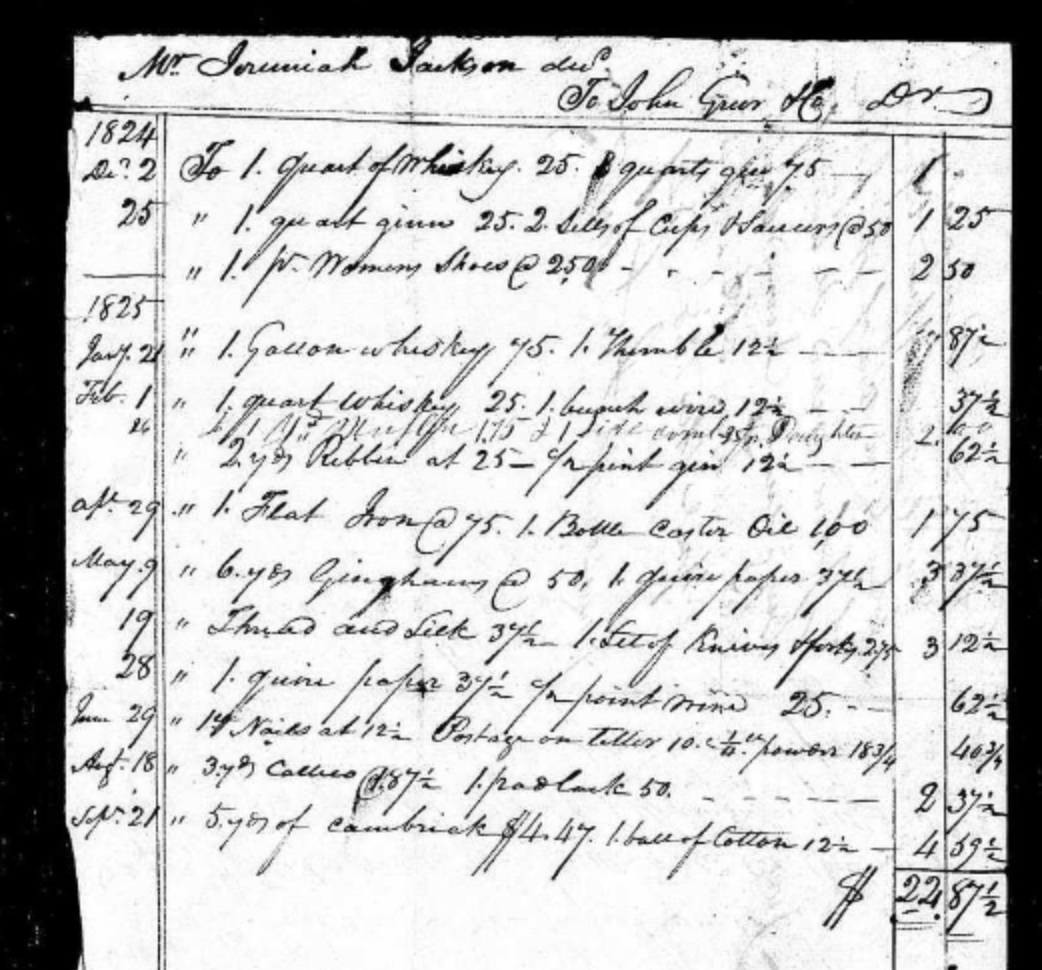
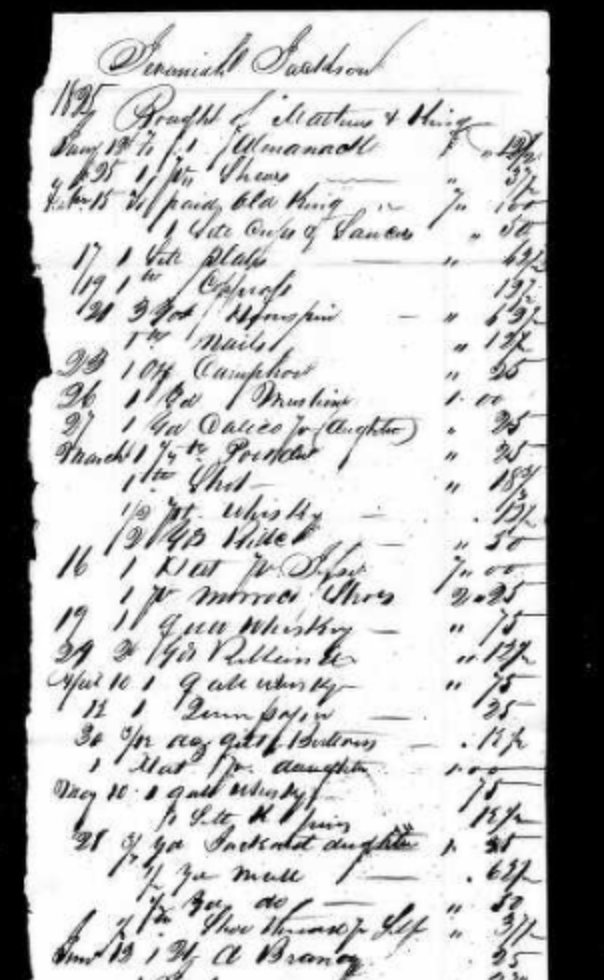
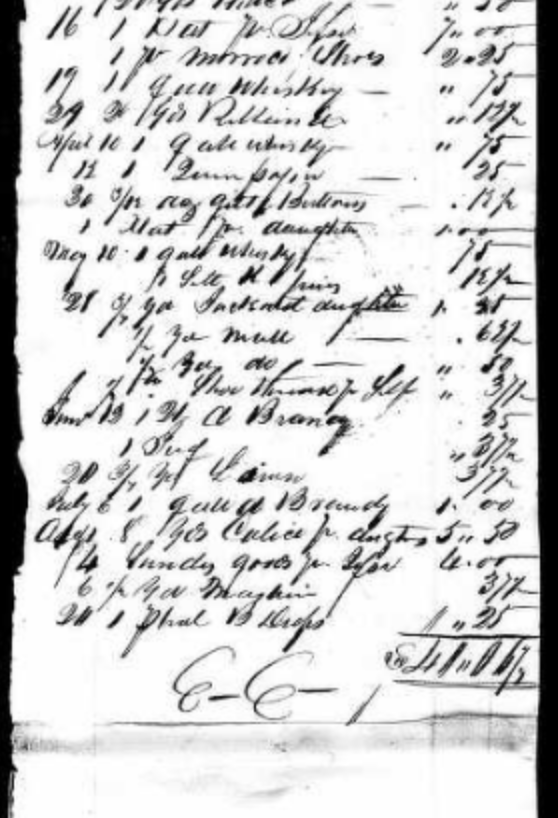
His 1828 will, drafted the same year he died, lists a number of seemingly random items for sale, including a thimble, six yards of gingham and an amount of camphor. But what stood out to me were the vast quantities of whiskey and gin listed over the course of several months — pints or even gallons at a time. In 1828, a gallon of whiskey was valued at 45 to 75 cents. Same for a gallon of gin. A gallon of brandy was worth a dollar (which is akin to $20 today). 

Some pages from his 1828 will:

Was he making his own spirits? Moonshine production didn’t really take off until after the South lost the Civil War, but that doesn’t mean he wasn’t doing it earlier. 

I’m fascinated by how different Martin Kauffman’s and Jeremiah Jackson’s wills are. Sure, they both mention some regular household items. But the bulk of their worldly belongings lean in vastly different directions. Minister’s gowns and semon books. Gallons of whiskey and gin. I wonder what would have happened if they’d met. What would they talk about? Would they get along? Although their DNA mingles in me, I can’t begin to guess. 

Poem A Week: Persephone Sees Her Reflection by Beth Winegarner

Photo by Margarita Zueva. Creative Commons.

Photo by Margarita Zueva. Creative Commons.

Hades, I might have gone with you if you’d asked;
left my flowers and the world of matter behind,
but then you gave me your seed. From then I had you.

You believe me trapped in your red honeycomb,
Each tart cell a prison room.
I will consume these chambers from within
and emerge, my mouth ringed blood-red.

You are the transforming darkness, o father,
but your shades must not be mistaken for power.
You cannot possess what is glimpsed shining in a vernal field,
for what is taken underground then knows decay

and what dies lives again. We are all remade
by your realm, or by our fear of it. Only you remain as you are,
those dead flowers in your grip, trapped at the gates.

Poem A Week: Topography by Beth Winegarner

Mount Tamalpais. Painting by William Keith, 1896.

Mount Tamalpais. Painting by William Keith, 1896.

I want to kiss you everywhere, my love;
every place you can think of, I will press
my lips: The head of Dorset's Lulworth cove
while sailboats bob in the sea's wet caress.
The grassy flank of Glastonbury Tor.
Across Glen Canyon's shoulders. The Qingzang
railway's steep spine leaves us breathless for more.
The foot of Mount Tamalpais, the tang
of sorrel. Within the belly of the tomb
at Newgrange, blowing life into the bones.
Every place we visit becomes a womb
where new kisses are born. A passion zone.
I will explore you from mountain to cove;
I want to kiss you everywhere, my love.

Poem A Week: El Molino, 1989 by Beth Winegarner

Screen Shot 2020-02-29 at 9.47.24 AM.png

The sun has dissolved the morning fog.
As the bell rings for lunch, a boy swings his leg
over the back of the gold-painted lion statue
behind the science building.
He grasps its unmoving mane, rocks
back and forth like it's an amusement ride,
lets his long hair shake free in the noon breeze.

On the mangy lawn nearby, a mosaic
Of boys lifts their legs into the air, ready 
To catch the one who runs at them, jumps, 
Rolls onto the wave of their limbs. 
They ferry him to the back of the group, 
Drop him into the grass, and the next one
Gets up to take his turn crowd-surfing. 

Behind the auto shop, more boys are 
Clustered, kicking a hacky sack between 
Their feet in a silent, jerky conversation. One
Rolls thin joints, which they smoke and pass
Around, skunk-scented smoke haloing 
Their rumpled heads. The scent lingers
In their denims as they return from lunch. 

In the classrooms, nothing sticks; math
Is for napping and flirtation, chemistry for
Formulating LSD for next week's beach
Bonfire, literature for tearing out pages 
To roll cigarettes, foreign language for 
Telling dirty jokes and impressing the girls
With absurd phrases about fish heads.