(This is NOT a bite-sized entry, apologies; it turned into something much bigger)
I’ve been researching my hometown, Forestville, for some writing I’m working on. I was looking through the California Newspaper Digital Collection (CDNC), because the Wikipedia article on the town mentions some kind of fire that took place in the early 20th Century and destroyed most of the early buildings. I didn’t definitively find any reports (though it could refer to this fire at the Lehn Winery in September of 1915 that resulted in a bunch of drunk hogs).
But I did find something else: Information about a multigenerational Japanese family that ran an apple farm in Forestville from sometime in the 1910s until after World War II. I’d like to share what I’ve learned, because it’s a story I never learned growing up there and I really wish I had.
Hichijiro Ito was born in Japan on May 10, 1875 (as I’m writing this, his birthday would have been yesterday). His mother’s name was Ecishi; I’m not sure what his father’s name was. His wife, Tomiye Mizutani, was also born in Japan, likely in 1881 or 1883. She most likely married Hichijiro in Japan and immigrated with him, though I was unable to find very much about her life. They had a son, Yoshinobu, who was born in Japan on October 12, 1905.
The Ito family came to the U.S. and settled in Forestville sometime in the 1910s. They set up an apple farming operation on Covey Road near Davis Road, where El Molino High School was later built. It’s worth noting that the apples were Gravensteins, which were a popular Sonoma County crop, brought to the U.S. by the Russians who settled at Fort Ross in the early 19th Century).
On November 7, 1923, a fire broke out on the Ito property, destroying two houses and damaging the Ito family’s apple-drying machine. The dryer had been used that day, but the boy who tended the kiln had made sure the fire was out before he left for the night. Neighbors said the fire started on the roof around 1 a.m., and a reporter suggested that a spark from the kiln became lodged in the vent and later ignited the roof.
Most critically, one of Hichijiro and Tomiye’s sons, likely Yoshinobu, was in danger from the fire. He was asleep in their home, but an unidentified someone ran into the house and pulled him from his bed.
The Oakland Tribune reported that the Ito dryer was located next door to the Sebastopol Apple Growers’ Union packing plant (another paper identifies it as the The Forestville Union Packing house). The fire could have spread to the packing house — and to the rest of the town —if not for “hundreds of people” who woke and came out to help fight the fire. Forestville, then and now, was an unincorporated part of Sonoma County and didn’t have its own (volunteer) fire department until 1938, so neighbors had to rely on each other when fires broke out.
Aside from the apple dryer and two homes, the fire consumed 20 tons of green apples and eight and a half tons of dried apples. Newspapers reported that the fire caused about $5,000 in damage (almost $100,000 in today’s dollars), $3,800 of which was covered by insurance.
The Santa Rosa Press Democrat reported that, after the fire, Hichijiro “is ready to rebuild, providing the residents do not object. The residents will no doubt object, as the drier was located near the heart of the town, which was in immediate danger, due to the inadequate fire fighting apparatus.”
I can’t help but wonder if that was the only reason neighbors might have objected. Although World War II was almost two decades away, anti-Japanese and anti-Asian sentiment was well entrenched across California.
Still, it appears the Itos rebuilt their operation. In July 1931, Hichijiro and his son Yoshinobu certified themselves as co-owners of a “retail green and dried fruit business under the name of H. Ito and Son” in Forestville.
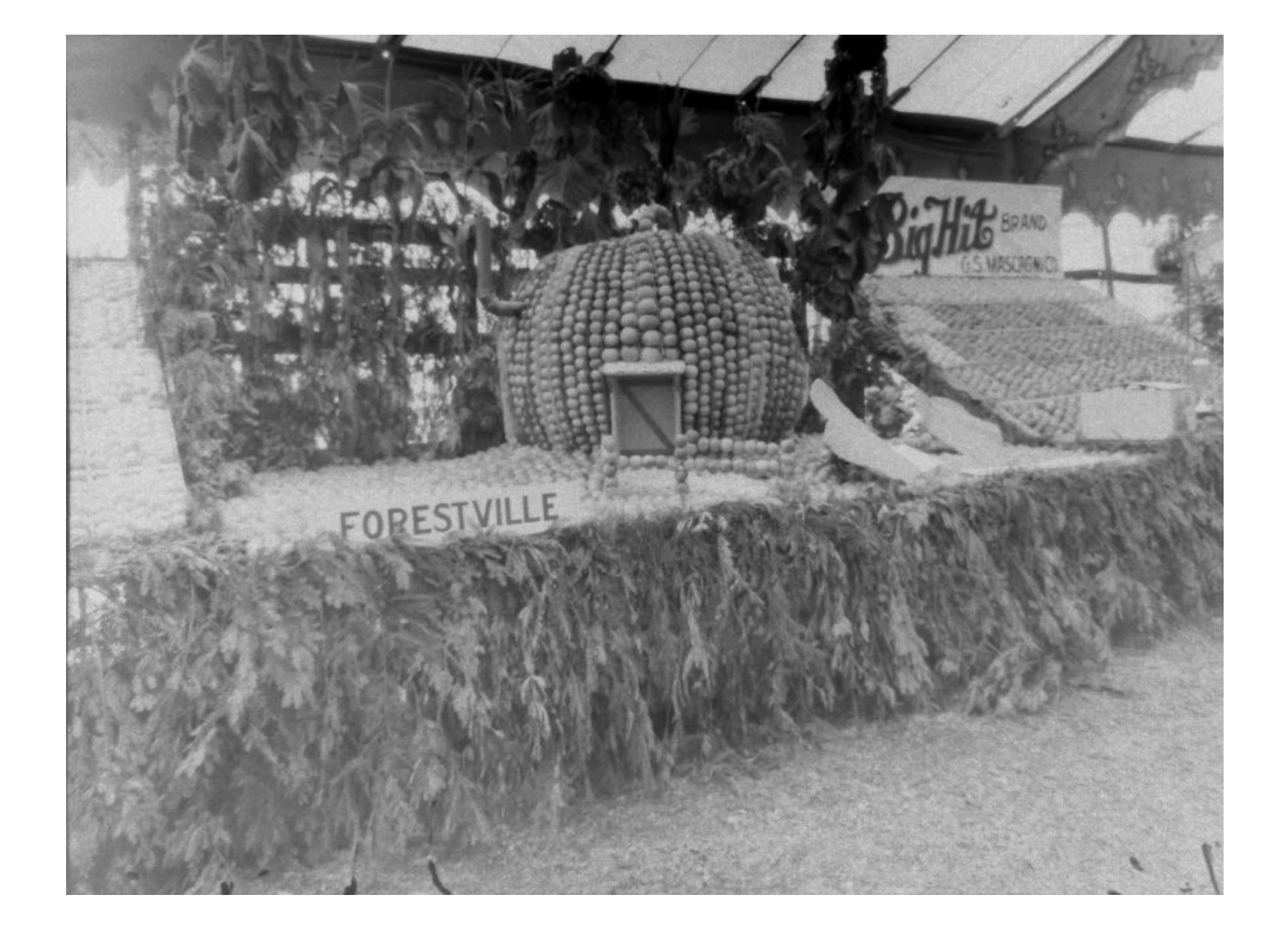
Circa 1930 Gravenstein Apple Show display of an huge apple, made of apples for the town of Forestville exhibit. Photo by William S. Borba.
Another member of the Ito family appears in the 1930 census, a boy named Kazuo, born December 8, 1922 and identified as Hichijiro’s grandson. Hichijiro and Tomiye had another son before Yoshinobu, but I have not been able to find much information on who he was. (He’s identified in this interview by the American name Frank, and in Kazuo’s obituary as Yoshimatsu.)
In mid-January 1932, Yoshinobu Ito, then 26, and Tsugive Hatanaka, 18, of Oakland, took out a marriage license. They were formally married on January 21, 1932, likely on the Ito property in Forestville.
The Santa Rosa Press Democrat reported:
Elaborate Japanese Wedding Is Performed at Forestville
FORESTVILLE, Jan. 21. An elaborate Japanese wedding took place here Sunday, uniting Tsugiye Hatanaka and Johnnie Y. Ito in marriage. All members of the bridal party and the minister were Japanese. The Rev. T. Friljii of the Sebastopol Japanese Methodist church performed the ceremony. Following the wedding, 200 guests were entertained at a bridal dinner with K. Akutagawa as master of ceremonies. Talks were given in both American and Japanese. The bride is a daughter of Mr. and Mrs. Hatanaka of Oakland. She was dressed in a white satin gown with a beautiful lace veil. The veil was held in place by a cap of lace and pearls. The bride was attended by the following bridesmaids and flower girls: Miss Jlatanaka, Miss Xishioka, Miss Kobuka, Miss Takemoto. Miss Ikeda, Miss Akiya and one of her younger sisters. Ro was supported by cousin, Tommy Ito. The groom is the youngest son of Mr. and Mrs. H. Ito and attended schools here. He is associated with his father in fruit growing and packing. The couple left Sunday night for a honeymoon trip to Los Angeles and other parts of southern California.
Yoshinobu and Tsugiye had two sons, Hiromu, born in May 1934, and Akira, born in May 1939.
On July 2, 1940, the Oakland Tribune ran an article about a rivalry between apple growers from Sonoma County:
Two produce firms this morning reported the receipt of Gravenstein apples, the first to be received in Oakland for the current season. Jack Oliver, of W. A. Rouse & Company, received a shipment from H. Ito, rancher of Forestville, Sonoma County. Ito usually "beats" his competitors. This year, however, V. Sangiacomo, of Sonoma, shipped to Angeli Brothers on the same day They were put on display by Joe Cellini of that firm. The fruit was quoted for from $1.85 to $2 per lug.
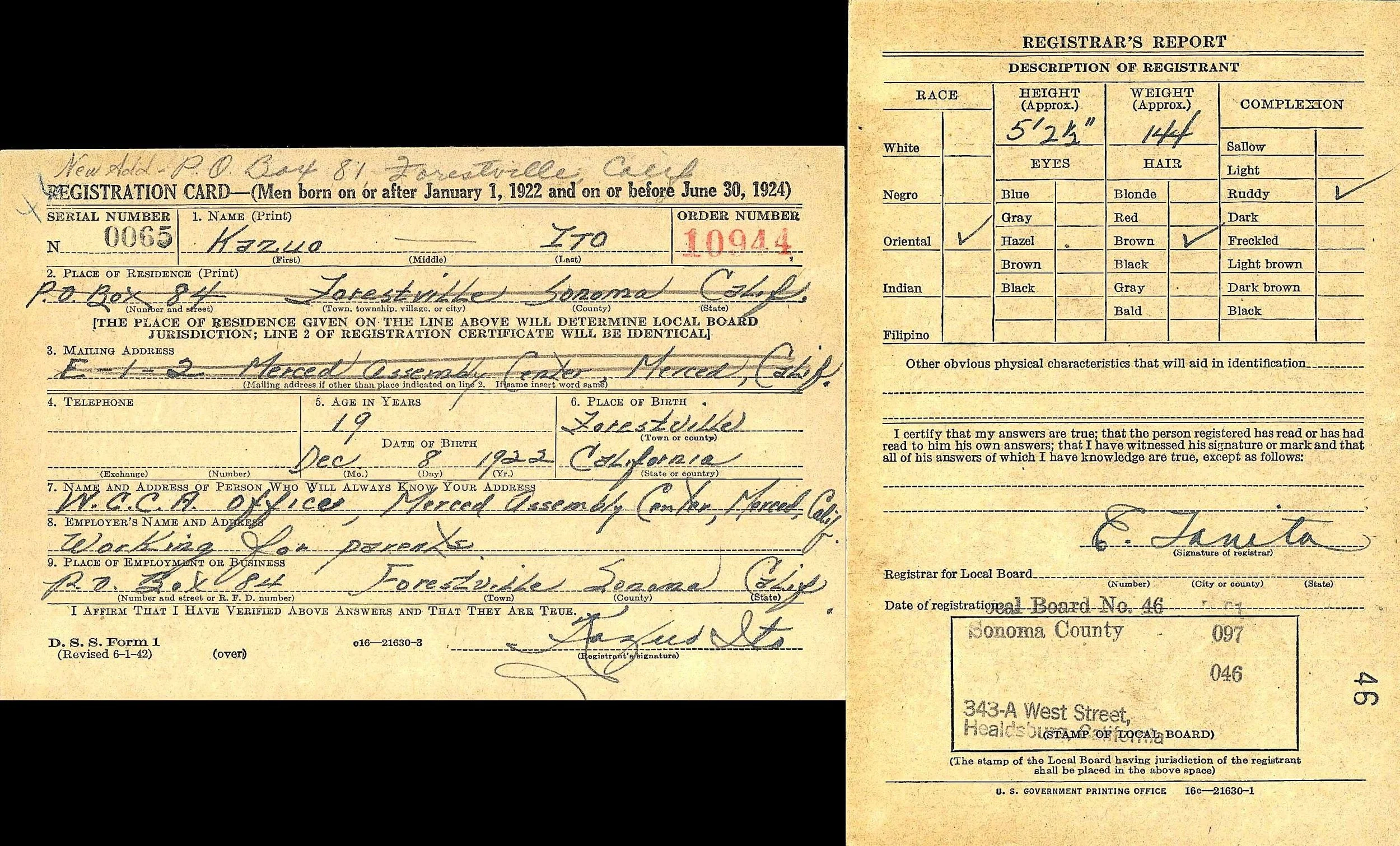
Kazuo graduated from Analy High School in Sebastopol in 1940. After World War II began, at 19 and a U.S. Citizen, he registered for the U.S. Draft. His registration card lists him as five feet two and a half inches tall and 144 pounds, with brown hair and a ruddy complexion. He reported that he was “working for parents” and gave an address of P.O. Box 84 in Forestville. He also listed the Merced Assembly Center in Merced, California as an address, but crossed it out.
The Merced Assembly Center was a temporary internment camp for Japanese Americans that operated for about five months between May and September of 1942 before prisoners were sent elsewhere. The U.S. kept Kazuo along with the rest of his family in Merced before sending them on to “Camp Amache” or the Granada War Relocation Center in Granada, Colorado, hundreds of miles from Forestville.
They were registered in Granada on September 9, 1942. Hichijiro was 67 and Tomiye was around 60. The little boys, Hiromu and Akira, were 8 and 3.
A friend of the family, Tom Perry, said in a 2003 interview that his parents took care of the Ito ranch while the family was imprisoned. He grew up playing with one of the Ito kids, whom he identifies as Keith (probably Hiromu). Perry said:
Anyway, I know that Johnny (Yoshinobu) ran the dryer and he and Sue (Tsugiye) lived on our ranch there for a while before the war and before they bought a place on Hurlbut Avenue (in Sebastopol). Their sons were Steve and Keith, who was just a few months younger than me, and Keith was my first playmate. I have a number of pictures where we were toddlers together. And Keith and I went all through school together, through grammar school, high school. I was four years old when the war began, so I don’t remember much of what was going on. I remember my mom talking about them being back in the camps. I knew about camping, that sounded like fun. So that was how much I knew back in those days when the war started and the internment situation took place.
While most of the Ito family were in Colorado, Hichijiro was accused of criminal espionage and shuffled around the country.
Tom Perry recalled:
So Grandpa disappeared. [He] was accused of being a spy. He was sent first to Louisiana, then to New Mexico. He was accused of having maps in his place. Maps! If you have maps in your house you’re obviously suspicious, and he was accused of having $40,000 sewn into his clothing. $40,000 in those days would be about a million today. Not too likely, but this was the story. Supposedly he was convicted. So he wasn’t able to join his family until 1944, when he joined the rest of the family in Amache. I’m not sure whether he was acquitted later. It was rumored this was the case, but for sure he was put away for some time for “committing the crime.”
Perry’s mom, Lea Perry, wrote letters back and forth with Kazuo while he was in Merced and later Granada, discussing and coordinating operations of the Ito ranch in Forestville from 1942 until they were released in 1945. Incredibly, all of these letters were donated and digitized, and are available to read online in Sonoma State University’s digital collection. The Itos apparently sent the Perrys small amounts of money in thanks for running the ranch in their absence, and at least once, Lea told them she could not accept the money, knowing they were receiving so little in the camp.
Lea also sent them gifts. Tomiye in particular loved persimmons, and Lea would send some on occasion. Tom Perry recalls:
In fact, I can still remember as a five year old, the persimmon tree. I didn’t know what they were so I bit into one one day, and (laughs) thought, this is not to eat. When they got ripe, Grandma Ito liked persimmons, so my mom would send them to her. Also apples and dried fruit. Of course, it was really appreciated. I remember one of the letters told about when they were in Merced, she shipped down a box of apples and Kaz said, “I grew up with these apples. We would even throw them from time to time, as kids, like baseballs.” He said, “I never realized how good they are and what a treat it was to have them.”
The Itos were released from detention on September 26, 1945 and most, if not all, returned to Forestville and Sebastopol.
It helped that the Perry family had been taking good care of their ranch and their houses in both towns. Tom also thought that the Itos had perhaps faced less racism in Sonoma County than Japanese people had in other parts of the country, possibly because they had been established in the area so long before the war. “I think that there were enough people here who knew the Japanese and what good people they were,” Perry said. “Also, people like my folks who took care of ranches, made people feel that their home was here, and that their places were here and they were cared for.”
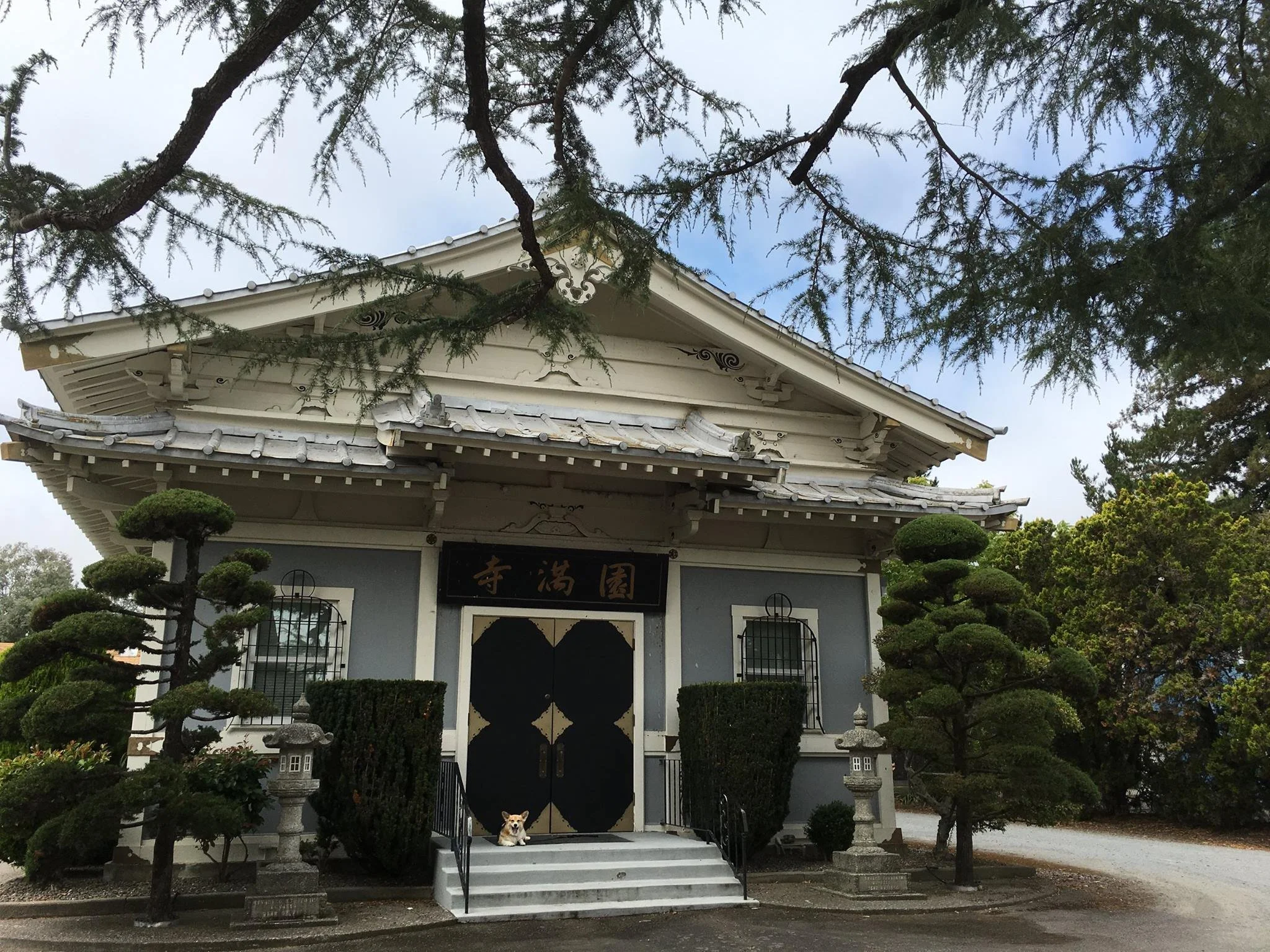
Enmanji Buddhist Temple in Sebastopol, California.
Perry also mentioned that Hichijiro was involved in establishing the Enmanji Buddhist Temple in Sebastopol. Before the temple, a Buddhist Sunday school and Japanese language school launched in 1926, and in 1928 a minister from the Buddhist Mission of North America visited the area to begin missionary work. Japanese Sonoma County residents met in 1932 to talk about establishing their own temple, and purchased a house in Sebastopol, opening the first temple space in 1933. Its first minister was Rev. Shodo Goto.
The current building, however, has an even more amazing story: It was constructed by workers with the Manchurian Railroad Company and used as part of their exhibit hall at the Chicago World's Fair in 1933. After the fair, the company donated the building to the Buddhist Mission of North America, which in turn offered it to the Sonoma County folks. It was dismantled in Chicago and transported by rail to Sebastopol, where it was rebuilt — without the use of nails — in early 1934.
Difficult news continued to follow the Ito family after the war. On June 30, 1949, a newspaper reported that “The friends of Kazuo Ito will be sorry to hear that he is confined in Oak Knoll hospital. He would appreciate hearing from different ones.” And in early November 1950, Hichijiro was released from Palm Drive Hospital in Sebastopol after undergoing two weeks of treatment for burns.
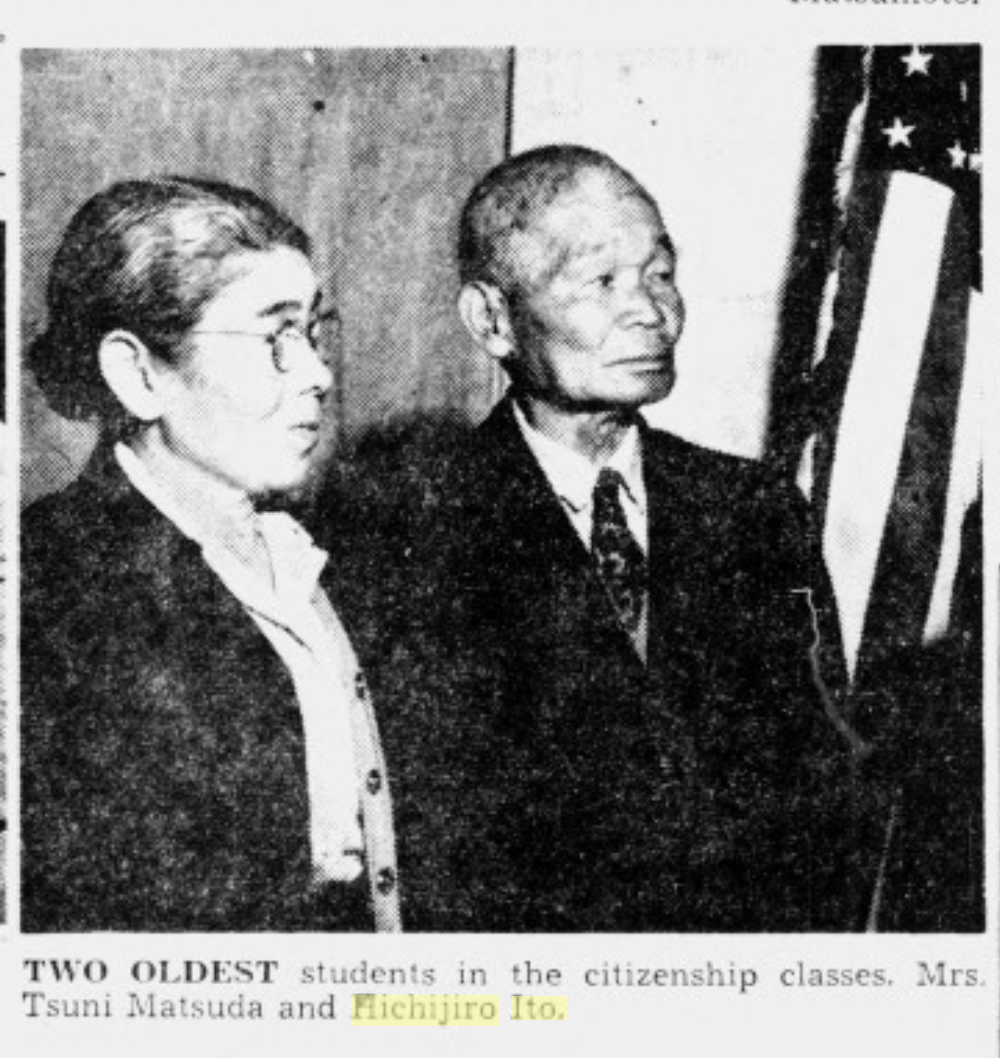
More cheerfully, Hichijiro was featured in a 1953 Press Democrat article about a group of 76 local Japanese Americans finishing a citizenship class so they could become naturalized in the U.S. Such classes were made possible by the 1952 McCarran-Walter Act, which made it easier for Asians to immigrate to the U.S., and for those already in the U.S. to become citizens. Among his classmates, Hichijiro was the oldest, at 78.
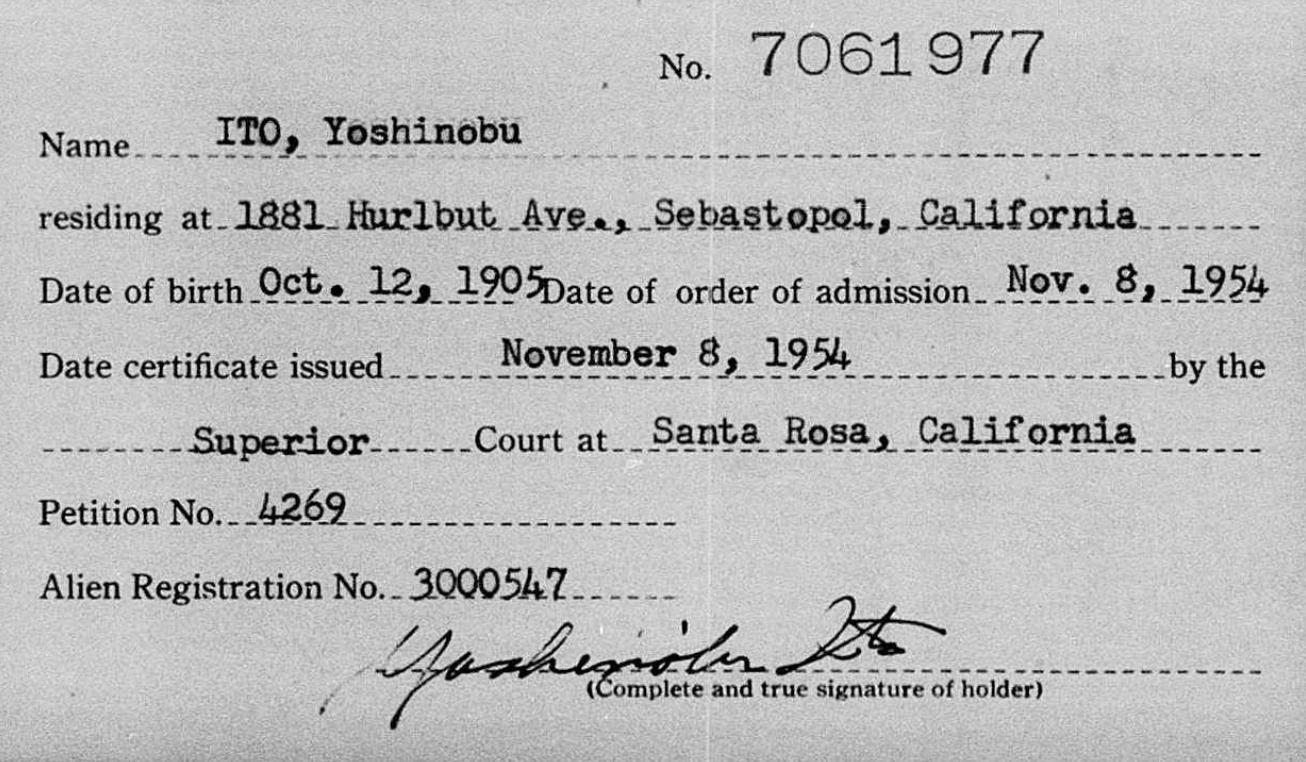
Yoshinobu became a citizen in November 1954.
Kazuo was the first of the Forestville Ito clan to die, on May 5, 1955, at age 32. The Enmanji Temple hosted his wake, and his ashes were committed at Chapel of the Chimes in Santa Rosa, according to the Press Democrat.
Hichijiro followed a few years later, in February 1958, at the age of 83. Like Kazuo, his wake services took place at Enmanji and his ashes were committed at Chapel of the Chimes. The Press Democrat reported: “Mr. Ito died Wednesday in a Santa Rosa hospital. He lived in Forestville 45 years after coming from Japan. He was an apple rancher on Covey Rd. He is survived by his wife, Tomie Ito, Forestville; sons, Yoshinatsu Ito, Sacramento, Yoshinobu Ito and Tom Ito, both of Sebastopol, and eight grandchildren.”
Yoshinobu died February 10, 1994 at the age of 88. Enmanji hosted his wake, and his ashes were inurned at Pleasant Hill Cemetery (now Pleasant Hills Memorial Park) in Sebastopol. The Press Democrat reported: “A native of Japan, he came to Forestville in 1920 to join his father in running an apple dryer and apple orchard. He was a member of the Enmanji Buddhist Church and the Japanese American Citizens League. Survivors include his wife, Tsugiye Ho of Sebastopol; his children, Steven Ito of Sacramento, Keith Ito of Concord, Philip Ito of Santa Rosa, Mildred Milne, Ft. Bragg and Katharine Legro of Calistoga; seven grandchildren and one great granddaughter.”
Tsugiye died in May 2022, and is also inurned at Pleasant Hill.
I regret that there are so many gaps in this account — I wasn’t able to find much information on Yoshinatsu or Tom Ito, or follow the lives of Hiromu or Akira, or locate details on the women of these families, especially Tomiye and Tsugiye. There is a much deeper story here to be told of the Ito family in Sonoma County, and Japanese American apple growers and farmers more generally. But I hope this will make it easier for family members and researchers in the future.