Talking with my mom's ghost about Jean Smart by Beth Winegarner

designing_women_cbs_14_copy_-_h_2018_0.jpeg

Warning: Contains spoilers for Mare of Easttown and Hacks.

In the mid to late 1980s, my mom and I had an evening routine. After dinner, we’d gather in the family room -- she in her pastel space-dyed armchair, me on the matching sofa -- to watch the evening’s primetime shows. Who’s The Boss?, Growing Pains, Moonlighting, Perfect Strangers, Kate & Allie, Head of the Class, Max Headroom, Designing Women.

We didn’t talk as we watched them, though we did laugh together pretty often. My mom was usually sewing a piece of her latest quilt project, or had one of the cats draped across her lap, while I curled up on the couch. I loved the easy escape these shows provided, someone to tell me stories in the hours between dinner and bedtime. When the shows featured teens, I felt a kinship with many of the girls and crushed on the boys, including Kirk Cameron, George Clooney (who was occasionally on Facts of Life), Michael J. Fox and Brad Pitt (who guest starred in an episode of Growing Pains). 

Even when there weren’t any kids, I often found something to like. The banter and sexual tension on Moonlighting. The futuristic mysteries of Max Headroom. I liked Designing Women because it included Annie Potts, who I’d loved in Ghostbusters and Pretty in Pink. But I can see why my mom liked it, too: it depicts an all-woman interior design firm in Atlanta, not far from where my mom grew up in Smyrna. Its leader was the tough, funny, resolute Julia Sugarbaker, played by Dixie Carter. I don’t know which of the women was my mom’s favorite, but I wonder if she had a soft spot for Jean Smart’s character, Charlene Frazier, whose highlighted blonde hair matched my mom’s. 

My mom died when I was 22, before I had the chance to have an adult relationship with her. I still think about her all the time, and wonder what we would talk about if she were still around. Would she still have the same sharp, punny sense of humor? Would she have adapted to using a smartphone, so we could text each other? Would we still enjoy some of the same television shows?

I recently watched Mare of Easttown and Hacks, both featuring Jean Smart, and found myself wanting to talk to my mom about them.

4be37d130617e1e6060a9e90867422cc5a-jean-smart-hidden-ice-cream.2x.w710.gif

I wonder what she would have thought of Helen, the angry, sarcastic matriarch Smart plays on Mare. Like her, would my mom be addicted to mobile games and snarking? Would my mom have laughed at Helen’s trick of hiding ice cream in a frozen veggie bag as much as I did? And what about Deborah Vance in Hacks? Would my mom giggle at all those cringey, dated Vegas jokes, or admire Vance’s unshakeable poise and confidence? 

In some ways, watching these shows allowed me to feel into the relationships between younger women and the doyennes Smart plays. In Mare it’s a literal mother and daughter, and Kate Winslet’s titular character is roughly my age, in her mid to late 40s. They live together, jointly caring for Mare’s daughter and grandson, quietly looking after each other through a thick layer of emotional reserve. They are central to a close-knit community where Helen had an affair with a neighbor and Mare’s investigating crimes that involve or implicate her friends. We lived in a similar small town, where my mom worked as an assistant at my elementary school and we couldn’t go into any shop for months after her death without hearing how much the staff missed her. 

With Hacks it’s less clear-cut. Ava, the young woman who begins working as a writer for Vance, is at least 20 years younger than I am, and much more brassy and loudmouthed than I ever was. Ava and Deborah slowly become friends, in part, because they are able to stand up to each other’s cutting remarks. I never could have done that, but then again my mom was kind-hearted, nothing like Smart’s hard-shelled Deborah. But as Ava learns more about Deborah’s life and career, I recognize my efforts to discover more about the life my mom rarely talked about. Ava eventually helps Deborah remember and embrace her whole self in a way I wish my mom and I could have done for each other. 

There are scenes in both series where these pairs open up to each other. In the final episode of Mare, after a family dinner at a local pizza parlor, Helen tells Mare, “Truth is, I was angry a lot. I was angry that your father wasn’t the person I thought I’d married, and I was angry that I couldn’t fix him, and I took a lot of that out on you. I’m sorry, Mare.” “I forgive you, Mom,” Mare replies. “Good, because I forgave myself a long time ago,” Helen says, before starting to cry. 

In Hacks, after Deborah and Ava have a fight so intense you’re sure it’s the end of their friendship and working relationship, Deborah comes to Ava’s dad’s funeral. In Ava’s childhood bedroom, they talk about grief and they make each other laugh even as they’re making each other cry. They move through the kind of reconciliation that I wish I could experience with my mom. We never got to talk, openly, on equal footing. I was always a kid.

It’s possible that if she were still alive we wouldn’t be watching the same shows, or having the kinds of conversations I imagine. But that’s okay. Seeing these series and getting to picture what we’d say to each other about them makes me feel like she’s still with me. 
Echoes in white noise by Beth Winegarner

PXL_20210508_193428883.MP_2.jpg

When I was in my late teens, I had a boyfriend whose family had worked at the Northern California Renaissance Faire every summer for years. I joined them for a couple of years, spending time at their feather fan shop or braiding ribbons at their friend Julia’s velvet-bag shop, wandering the dusty trails, sipping spicy iced chai or savoring waffles and ice cream.

The event wasn’t exceptionally loud, but it provided a steady hum of voices — people talking and singing — as well as medieval bands and musicians playing their instruments as they ambled up and down the paths. Each weekend, I would come home and soak in a long bath to wash off the dust, sweat, fire retardant and anything else my body had accumulated after two days in the dry California oak woodland. And, as the warm water rumbled and filled the tub, I thought I could hear the murmur of voices and the sound of pipes and flutes amid the white noise.

I was amused to hear these ghosts of the weekend, and often leaned in to hear conversations and melodies that weren’t quite there.

This past weekend, I rented a house in the Santa Cruz Mountains — a place that often feels haunted to me, after experiences I had there 20 years ago. After more than a year being at home with my partner and kiddo, I needed some extended time alone. I love them dearly, but I was wiped out from the lack of solitude. (In a recent interview with the Pleasure Mechanics, author Emily Nagoski described her similar situation as like being tied to a chair and force-fed chocolate.)

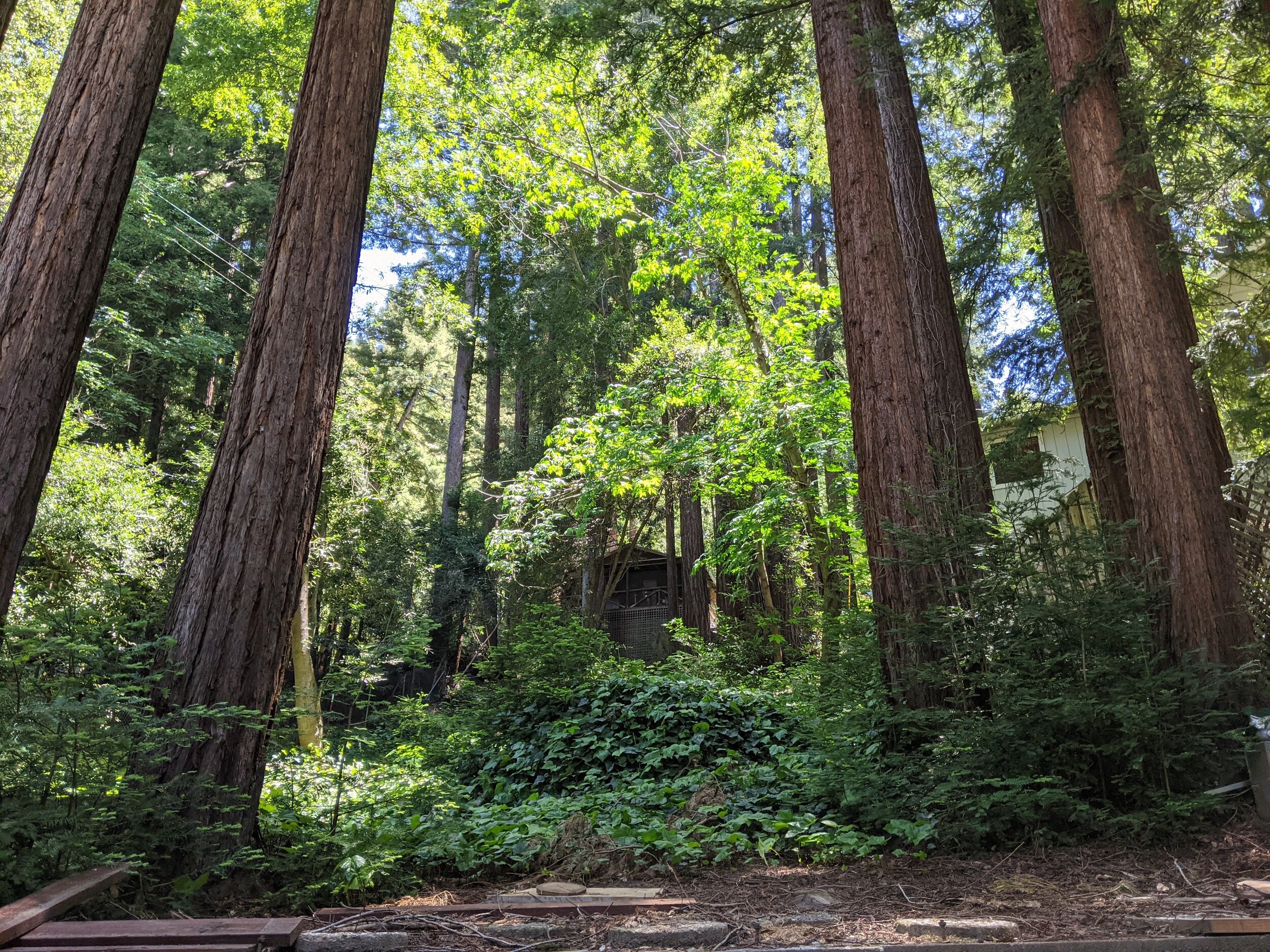
The house was surrounded on all sides by redwood trees — which was one of its major selling points for me. The whole weekend, ravens flitted from tree to tree throughout the canyon, cawing and cackling and croaking at each other. The only time it got a little too loud was when one of them hopped around on the flat roof over my head, cawing its head off.

When I came home yesterday afternoon, I rested in bed with a portable fan blowing cool air across my skin, and I could hear the echoes of the ravens’ calls. They were faint but unmistakable above the hum of the fan, an artifact of my brain subconsciously dancing along a weekend of raven-song. I hadn’t thought about that phenomena in a long time, and it made me smile.

It took me almost three weeks to recover from the Covid-19 vaccine, I think? by Beth Winegarner

Pins created by my brother, Tyler Winegarner. Buy them at his Etsy shop.

Pins created by my brother, Tyler Winegarner. Buy them at his Etsy shop.

As of April 21, I’m fully vaccinated against Covid-19, meaning I’ve had two doses of the (Pfizer) vaccine and my second dose was on April 7. I had some health issues after each dose that I suspect were long-lasting side effects, and I wanted to share them here because I’ve seen so little written about this. Note that I am not a medical professional; I am just sharing my own experiences. 

I had my first shot on the morning of Wednesday, March 17. I started feeling tired that afternoon and took a nap. I slept pretty well that night, and napped again the following day. On Friday I felt pretty good, and I thought that was the end of it. But over the weekend I had a low appetite, some nausea, and some other GI irritation. Going into the next week (of March 22), I started having cold symptoms: fatigue, sneezing, congestion, sore throat and a mild fever (99.1-ish). Those lasted for a few days and I was feeling pretty okay by the end of the week. 

I got my second shot on April 7. I felt fine that evening and a little tired the next day, but that was all. But then, on Friday April 9, I developed chills and another mild fever (low 99s), which lasted for about 36 hours. On Sunday I felt good, but on Monday (April 12), I developed GI symptoms again that lasted about 48 hours. Another round of cold symptoms followed: lots of fatigue, runny nose, sneezing, sore throat, and some serious brain fog. These continued through the weekend of April 17-18. I’ve felt a bit better each day since then, but some mild fatigue has lingered, and I’ve slept hard every night, which is unusual for me. 

I wouldn’t have thought much of it, except that the pattern of post-vaccine side effects were so similar both times. I wondered if maybe I had a virus, but nobody else in my household had any signs of illness. My instinct tells me that these waves of symptoms were the way my body mounted its immune response to the vaccines. 

I asked on Facebook whether anyone had had prolonged symptoms after their shots, and I got some responses in the affirmative. In particular, some of my friends with fibromyalgia (which I also have) said they had longer reaction times, as though the vaccine had perhaps triggered a fibromyalgia flare. Some of what I experienced felt that way, too, especially the fatigue, malaise and brain fog. Anecdotes are not data, but it seems like an experience worth noting. 

It’s now three-plus weeks since my second shot, and I’m pretty much feeling back to normal. I’m grateful to have this protection from Covid-19, and don’t regret that I got vaccinated. But my experience makes me wonder how many other people had longer recovery times from the vaccine, especially the second one. Dr. Jen Gunter recently noted that our lymph nodes can remain swollen for four to six weeks after the second dose, so clearly our immune systems are still working hard for weeks after these vaccines. 

What about you and your family? Did anyone you know have a longer reaction time to the vaccines?

Do You Feel What I Feel? by Beth Winegarner

claudio-schwarz-purzlbaum-k39RGHmLoV8-unsplash.jpg

Many years ago, a boyfriend of mine discovered that he could tickle me by tickling (or even pretending to tickle) his own body. When he did this, I felt the creep-crawl of tickly fingers on my own skin, and it made me shudder and squirm. Neither of us understood why.

I’ve had many other instances in my life when I could feel the touch on someone else’s skin, or the shock of pain at seeing a wound on another person’s body. But I’ve only learned in the past few years that this is a real thing that happens to some people, and it has a name: mirror touch synesthesia.

From Wikipedia:

Mirror-touch synesthesia is a rare condition which causes individuals to experience a similar sensation in the same part or opposite part of the body (such as touch) that another person feels. For example, if someone with this condition were to observe someone touching their cheek, they would feel the same sensation on their own cheek. Synesthesia, in general, is described as a condition in which a stimulus causes an individual to experience an additional sensation.[1]

There’s some research suggesting that mirror touch synesthesia is connected to sensory processing disorder and/or being on the autism spectrum. Jenara Nerenberg, author of the book Divergent Mind, argues that synesthesia in general is one form of neurodivergence, along with ADHD, sensory processing disorder, being autistic and being highly sensitive. I suspect there are a lot of overlaps among these various differences.

Mirror touch synesthesia reminds me a bit of Earthseed protagonist Lauren Olamina’s hyperempathy syndrome. When something pleasant or harmful happens to someone around here, such as a hug or a stabbing, she can feel it as though it were happening in her own body. This becomes difficult when she has to defend herself against attackers. Several critics have called Olamina’s condition "fictional” or even “delusional.” It’s not clear whether author Octavia E. Butler knew about or had experienced mirror touch synesthesia when she was writing the Earthseed books. Did she borrow the idea from real-life experiences? I wonder.

Olamina considers whether her hyperempathy is a positive or negative thing. "But if everyone could feel everyone else's pain, who would torture? Who would cause anyone unnecessary pain? I've never thought of my problem as something that might do some good before, but the way things are, I think it would help. I wish I could give it to people.”

Although I don’t enjoy unexpected touch, and mirror touch synesthesia can sometimes feel that way, it doesn’t feel like an illness or disability. Mirror touch synesthesia isn’t the only type I experience; I also occasionally have color-gustatory synesthesia, where certain colors (particularly intense colors) will also have a flavor. I’ve known a lot of synesthetes in my life and, for the most part, most of them were glad to have this additional conduit of sensation — as long as it didn’t become overwhelming. But many people go through their lives not realizing synesthesia exists, or that there are so many different kinds. Either they grow up believing everyone experiences this (and later find out they don’t), or they feel like they’re the only ones experiencing this strange sensory crossover (they aren’t).

I try to talk about this stuff year-round, but April is autism awareness month, which is one reason I’ve been blogging about sensory-related issues this month. You might also be interested in following my Instagram account for sensitive folks, @sensitiveenough.

Do you have synesthesia? What kind? Does it feel like a blessing, a hindrance, both, or something else?

The Sensory Accessibility Checklist by Beth Winegarner

San Francisco’s Apple Store in Union Square. Photo: Nigel Young/Foster+Partners.

San Francisco’s Apple Store in Union Square. Photo: Nigel Young/Foster+Partners.

Last month, I visited my daughter’s pediatrician’s office for her annual checkup. We have been going there since she was a newborn, and the office has changed little in the past 12 years. It has the same wood-paneled waiting room, the same small windows in the exam rooms, the same deafeningly loud fan in the bathroom. Every time I use it, it’s a race to finish and wash my hands before the low, roaring sound causes me to have a sensory meltdown. (I should probably email them about that.)

The pediatricians’s office was designed for economy, but even businesses with high-end design can be difficult for sensory-sensitive people to cope with. Take the Apple Store in downtown San Francisco: the second floor of the building is devoted to computer repair, but when you enter the space, it’s a wide-open room with no clear spot to line up or speak to someone in charge. It’s bright, loud and confusing.

These are accessibility issues for the 5-16% of us with sensory sensitivities, similar to how the absence of wheelchair access and braille signs is an accessibility issue for wheelchair users or people with vision loss. Just as there are checklists to make sure public spaces are accessible for people with a variety of physical disabilities (as required by the Americans with Disabilities Act), I have created one to help people create businesses, workplaces and other public spaces that are more accessible to people with sensory differences. This isn’t required by the ADA, but it’s good practice nonetheless, and it creates spaces that everyone feels more comfortable in — not just people with sensory differences.

You can see and download it here.

I developed it with the help of the folks in a large Facebook group for adults with sensory processing disorder, as well as my neurologist, who has studied and treated kids and adults with SPD for years.

If you’re designing a business, workplace, or another space that will be used by a variety of people, please consider using the checklist as you’re creating those designs. Your customers, guests and employees will be grateful.

🎵 (Partially) vaccinated and it feels so good 🎵 by Beth Winegarner

0717CoronavirusVaccine_SC.jpeg

I got my first Covid-19 vaccination last Wednesday, the Pfizer version. After a few months of watching my elders and friends in healthcare get their shots, it felt strange for it to suddenly be my turn. I was giddy as I chose the dates for my shots and confirmed the appointments. 

My arm was sore and was really tired for a couple of days after the shot, and I napped a lot. It reminded me a lot of when I get flu shots. Other than that, I felt fine. I expect the next one will have more side effects.

Although I have a number of health conditions (fibromyalgia, thyroid disease, etc.), none of them qualified me for the vaccine. But my weight does. 

That made me feel really conflicted. On the one hand, weight and health are not strictly correlated. I don’t have any of the diseases commonly associated with weight gain. My blood sugar, cholesterol, heart and lungs are all healthy. 

While it’s true that many bigger-bodied people have heart disease or diabetes, it’s more likely that weight gain, heart disease, diabetes (and others) stem from the same causes: chronic stress, especially coupled with traumatic childhood experiences, such as divorce, abuse, loss of a parent, or living under systemic oppression. Nadine Burke Harris, California’s Surgeon General, writes about this in her book The Deepest Well

On the other hand, one study shows that people with higher weight/BMI had worse outcomes when they contracted Covid-19. But most of those didn’t just have higher weights; they also had high blood pressure, heart or kidney disease, or another risk factor, so it’s tough to say for sure that weight alone was the issue. 

Also, we don’t know how many of those people might have avoided their doctors early on in their covid infections because they’d been fat-shamed and dismissed in the past, or how many avoided hospitals until they couldn’t anymore, knowing that overwhelmed hospitals may de-prioritize them. 

I don’t know whether I agree that weight alone makes me more vulnerable to covid infection (and there’s also the chance I already had it), but when California said it was my turn to get vaccinated, I was glad to sign up. I’m relieved to be on my way to protection -- not just for myself, but for my family, for the kids in my child’s classroom, and for the employees at the stores I visit. I’m looking forward to it being your turn soon, too.  

To all the kitties I've loved before by Beth Winegarner

I’ve lived with cats for most of my four-plus decades on this planet, and I’d like to introduce you to (most of) them.

tommy-nursing.jpg

This is Tommy. It was taken in the first few weeks after I was born; my mom was feeding me and Tommy decided to get in on the snuggling. He looks pretty pleased with himself.

cricket-bed.jpg

Cricket. We got Cricket and her brother, Fred, from Amir, our neighborhood mechanic after his cat had a litter of kittens. Fred died a few years after we got him, but Cricket was my heart-kitty through most of my adolescence and early adulthood. She was such a sweetie, and loved snuggling and sleeping in with me on the weekends.

sunshine-porch.jpg

This is Sunshine. It’s hard to tell from this picture, but she was a long-haired tortie cat (with the attitude to match). When we adopted her I wanted to name her Panther, but my parents overruled me. She was born with a tail, but had a habit of sitting in the street with her tail jutting into it, and we think she got it run over by a car — she came back to the house with a dislocated and fractured tail. The vet amputated it and she quickly learned how to balance without it.

macaroon-porch.jpg

Here’s Macaroon. He and his brother Willie came to us from our neighbors, Arrow and Rio (that’s their house on the other side of the fence in the background). He was a sweet and very social cat who grew very round in his later years. He loved hanging out with people, even people he hadn’t met before, and his meow was more of a quack.

willie-fish.jpg

And here’s Willie. I don’t have many pictures of him; he also died pretty young. He’s still a kitten in this picture, and he’s inspecting the fish tank close-up. (I love that this photo also features my brother, my encyclopedias, my Garfield and Duran Duran posters, and my Singer Featherweight sewing machine.)

emerald-quilt.jpg

Meet Emerald. We adopted him and his brother, Merlin, from Eric, my boyfriend at the time. Merlin ran away to live with another household in the neighborhood but Emerald stuck around. He preferred hunting for his food (birds, mice, etc.) over eating the food we provided him, and had a corner of the yard where he would store leftover critter parts, sorted by type: feet, beaks, wings, and so on. He also really enjoyed “helping” my mom make quilts.

mac-emerald.jpg

Later in life, Macaroon and Emerald bonded with each other. They slept curled up together a lot of the time, and Macaroon would give Emerald extensive baths. They really loved each other and it was so sweet.

mouse_4483710622_o.jpg

This is Mouse. She was my partner’s cat for the first few years, but lived with both of us after we moved in together in 2001. Even though she was part of a litter of mixed-coloration kittens, she came out looking like a French Chartreux. She was beautiful and smart — she learned a bunch of facial expressions from us, which was pretty funny. Despite being a bit antisocial, she loved laying on my pregnant belly and was gentle with our kiddo as a baby and toddler.

pigeon_43280814601_o.jpg

And here’s Pigeon. We adopted her from the SF SPCA about six years ago, when she was a brand-new and recently spayed mama. Her belly was shaved and stitched up, and her nipples were still full of milk. She was very skinny and her coat was scraggly and she farted every time she jumped onto or off of something. We soon discovered she has a lot of sensitivities and allergies, got her onto some more appropriate food, and she began to look and smell a lot better. She’s not a terribly smart cat, she’s quite anxious and she has asthma, but she’s also a total love.

Finding unexpected validation in the doctor's office by Beth Winegarner

robina-weermeijer-Pw9aFhc92P8-unsplash.jpg

In mid-July of 2020, during one of the early Covid-19 spikes, I developed a cluster of covid-like symptoms: shortness of breath with any exertion and even with talking, chest pain when I breathed, extreme fatigue, mild fever, muscle aches, and an occasional dry cough. I got a nasal-swab test; it was negative, but at the time, false negative rates were roughly 20-30 percent. I also got a chest X-ray, which showed my lungs were clear. After a couple of weeks, the fever subsided, but the fatigue lasted at least a month and the shortness of breath lingered for months. 

My doctor referred me to a pulmonologist, who was brusque and dismissive of me from the first meeting. She told me that the covid test I’d had -- a gentle swab inside the opening of the nostrils, not the one that goes all the way to your brainpan -- was garbage.

But she also told me that, since I’m fat, it was more likely reflux causing my lung symptoms. And also, because I sometimes have trouble sleeping, I probably also have apnea. (She wasn’t just a pulmonologist, but a sleep doctor). 

I tried explaining to her that I have sensory processing disorder, and I wake up at the slightest unusual noise or movement at night, and that’s why I don’t sleep well. “It’s possible that you have … whatever that is,” she said disdainfully, “But apnea is very common in people of your size.” Never mind that we were on a video call and she could only see me from the shoulders up, and had no idea what size my body was.

Unfortunately, I’m accustomed to having interactions like this with doctors. I’m fat, I have fibromyalgia, I’m neurodiverse and I’m well educated on my own health. I do a lot of self-advocacy in the doctor’s office, and some doctors don’t like it. They also don’t always know how to handle it when someone turns up in their office with so many unfamiliar conditions (even though none of them are particularly rare). 

I stopped seeing that pulmonologist. My GP put me on a steroid inhaler, which was the first thing to really bring my lungs any relief. After a month of breathing freely, I met with a different pulmonologist, who took my history again. He said right away that my symptoms strongly suggested I’d had a virus that affected my lungs, and that covid was entirely possible. He also said that lasting shortness of breath was common after these kinds of viruses, and that sometimes a miscommunication between the nerves in the throat and the nerves in the chest/lungs can be part of the problem. 

I laughed. “No, it really can happen,” he said.

“I believe you,” I said. “I have fibromyalgia -- my nerves misfire pretty often.”

He didn’t question it. At all. 

He referred me to UCSF’s voice and swallowing center, where they would check for any signs of a nerve issue. On the day of my visit, the speech-language pathologist talked me through my history. Again, she mentioned the potential for nerve systems misfiring. When I mentioned I have fibromyalgia, she nodded knowingly. “It’s really common for folks with fibromyalgia to have these kinds of issues. We see it all the time.”

My body warmed with relief. It’s rare enough to find healthcare workers willing to take fibromyalgia seriously, let alone ones who are familiar with treating patients like me. 

“We also find that this happens in patients who have a lot of sensory sensitivities,” she said. 

“That’s me, too!” I said. Of course, I’m not at all surprised -- people with sensory sensitivities are more likely to develop chronic pain conditions, and vice versa. But not that many people in health care seem to be aware of that. 

I thanked her for being familiar with these things, and she smiled. And then, when it came time to numb my sinuses and run a scope through my nose and down into my throat, she did two things that really helped: One, she explained everything she was about to do. And two, she got the tiniest scope possible, the one they use for infants, so it would cause me the least discomfort. 

I’ve written before about having to craft my own healthcare procedures. It’s exhausting, and shouldn’t be necessary, but it’s also worth it. So it was a huge surprise and relief to be taken care of -- without having to do any of the work myself. Why can’t more medical appointments be this way?

I still don’t know if I had Covid-19. My lungs feel a lot better, and the voice and swallowing center didn’t find anything wrong with the nerves in my throat. And I’m grateful that, at that appointment, I felt genuinely seen.

We Are Here to Help Each Other by Beth Winegarner

Photo by Ralph (Ravi) Kayden/Unsplash.

Photo by Ralph (Ravi) Kayden/Unsplash.

When we’re together, humans constantly influence each other’s emotional states. A grumpy person on our bus can leave us feeling cranky, while a calm doctor can soothe us from the moment she enters the exam room. When our kids or partners are testy, it can make us short-tempered, escalating a moment of tension into a fight. And when we snuggle into a loved one’s arms, both of us quiet and breathing slowly, we settle into a bubble of calm and safety.

In psychology, this is often called “co-regulation,” especially that last example. Scientist Stephen Porges believes that humans, like all mammals, were designed to settle their nervous systems in connection with others. We learn to self-regulate through the safety that co-regulation teaches us, and teaches our bodies.

“Our ability to achieve a state of regulation—and especially to be able to support others who are in distress—actually comes from our capacity and opportunity to lean on support ourselves. And we need the support of not just one strong relationship, resiliency research shows, but of many. We need a distribution of support, so that we have access to a wide range of relationships to keep us resilient without overtaxing any one of them,” Porges said last year.

Growing up and even now, it’s hard for me to feel 100% safe leaning on other people for support and comfort. I think it’s for a combination of reasons: being on the autism spectrum has made it more difficult for me to understand human behavior sometimes, especially when I am too trusting and wind up getting burned. I’ve been hurt a lot by people, and I’m still learning that, while some interpersonal harm is abusive, we also accidentally hurt each other even in the best of relationships. And then we mend again.

Co-regulation doesn’t happen only between mammals of the same species. Anyone who’s had a close relationship with a cat, dog, horse, or other sweet critter knows that we can soothe and support each other across species. For much of my life, I’ve sought comfort and safety from animals, cats in particular. They have helped me immensely.

The brilliant folks at Queer Nature talk about the idea that co-regulation can go beyond mammals, beyond other critters, to other beings in nature (trees, stones, rivers), or the earth itself. As someone who instantly settles down when I am among trees or by the ocean, I love the idea of co-regulation with these spaces. But is it “co”? Am I helping them return to calm and safety in the way they’re helping me? Sometimes I would swear I feel a tree lean into me when I lean against it, or the playfulness of water as it laps around my ankles, certainly.

Getting to these ideas, and accepting them, can be challenging, especially for those of us raised in white privilege, a white/human supremacist culture, and/or in a culture that values individualism and doing everything on your own. Humans in leadership have been dismantling close connections to nature for centuries, especially in an effort to eradicate those connections among the indigenous people of the Americas. But when you look at how many ways different species rely on each other for survival, it begins to make more sense. In her book Braiding Sweetgrass, Robin Wall Kimmerer writes about how the sweetgrass grows better and healthier when some of it (about 50 percent) is harvested by humans. Or think about how our gut flora couldn’t live without us, and we couldn’t live without them. Nature is full of such examples.

I have been reading these ideas and absorbing them, ironically, in an effort to reach out more often to my fellow humans for help, comfort, and safety. I’m lucky to be at a point in my life where I have a lot of people around me who understand the value of community, particularly communities of care, and of not enduring something alone. And, slowly, it’s getting easier to reach out to them when I need. But that hasn’t diminished the value, for me, of finding comfort with my kitty, the shoreline, the birds in my backyard or a quiet grove of trees. I’m very lucky to have that, too.

Tell Me Baby All Through the Night by Beth Winegarner

Mike Tramp of White Lion.

Mike Tramp of White Lion.

When I was in my teens and 20s, I would occasionally have dreams in which I became friends with a musician I admired. We would take long walks together, talk for hours, snuggle and hold hands. Or I would dream that something stressful was happening, but then suddenly Metallica would arrive and start playing music, launching a fun, impromptu party that made all the stressful things go away.

It’s common wisdom, especially these days, that everyone (and everything) in our dreams is an aspect of ourselves. I’ve written about how I fell in love with hard rock and heavy metal as a teenager, because the music comforted and soothed me so much. I also had crushes on many of the musicians, both because they were so good-looking, and because they made music that was such a good friend to me.

I dreamed at least once of spending a day with Guns N’ Roses singer Axl Rose. Although I now see him as a very problematic (and racist, homophobic, and misogynist) person, as a teenager I saw him as a troubled/wounded soul. Sometimes I imagined I could heal him; other times I’m pretty sure I identified with his woundedness. In the dream we talked and talked and hugged and hugged. It was really sweet.

In another dream I met up with White Lion singer Mike Tramp in Copenhagen, and he showed me around the city as we talked and held hands. At the end of the day — I still remember this clearly — we sat on the stoop outside his house and snuggled. Tramp projected an image of a good-hearted guy, deeply worried about the state of the planet and unafraid to love. It was that sweetness that came through in the dream.

I wrote to Tramp about the dream, telling him all the details and how I wished we could be friends in real life. He didn’t reply. That’s okay.

These days, I see these dreams as an effort on the part of my subconscious to befriend and love different parts of myself, whether it’s a part that feels broken, a sensitive part, or a part that wants to soothe a tense situation with music and joy. In them I felt so much peace and love, and I’d wake up missing the person I’d dreamed of. That was the hardest part. They felt so real.

I rarely have such dreams anymore. I miss them.