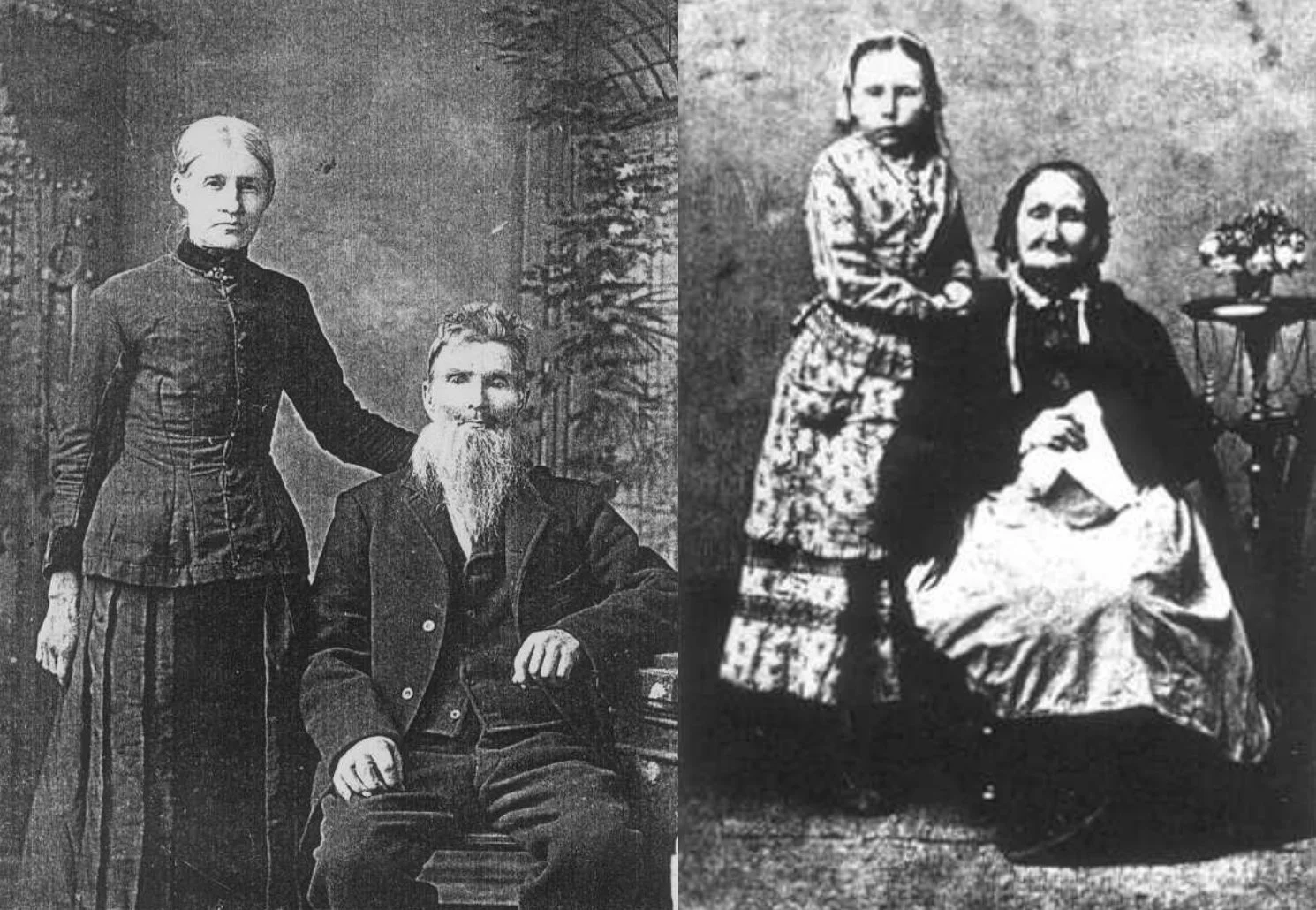
Left: Rebecca Lakey and Levi Davis. Right: Lydia Davis with her grandmother (and Levi’s mom), Rebecca Jack.
Content warning for discussion of domestic violence and suicide.
Levi Davis wasn’t the first settler of Forestville, but he was one of the early ones.
Born in Indiana in 1822, he married fellow Hoosier Rebecca Lakey in 1842, when she was 15 and he was 19. They lived in Missouri for several years before arriving in California and settling in Petaluma with their flock of eight children. Their youngest, Lydia, born in 1865, made nine.
Levi was a farmer, which meant he could pick up and move just about anywhere there was good land. By 1870 the Davis clan was living in Forestville, across the street from where the El Molino/Laguna High School campus sits now. Davis Street is named for them.
I should point out that the Southern Pomo were living happily on the land along the Russian River for thousands of years before settlers arrived, tending the river and the redwoods, including the areas that later became Forestville. This was not untouched, vacant, free land, and probably most of Forestville (like most of Western Sonoma County) was covered with redwoods before settlers came.
One of the first settlers was Captain Juan Bautista Rogers (J.B.R.) Cooper (brother-in-law to General Mariano Vallejo), who set up shop northeast of town along Mark West Creek in 1834 and built a water-powered sawmill that hastened the destruction of the redwoods. In the 1860s, saloonkeeper Andrew Jackson Forrester purchased 100 acres of land, set up a new saloon and hotel, and named the town (Forrestville, at first) after himself.
As other settlers arrived, early roads were laid out, and were usually named after whoever built a house there. Travis, Templeman, Anderson, Ross, Covey and Van Keppel roads (and many more) all got their names this way.
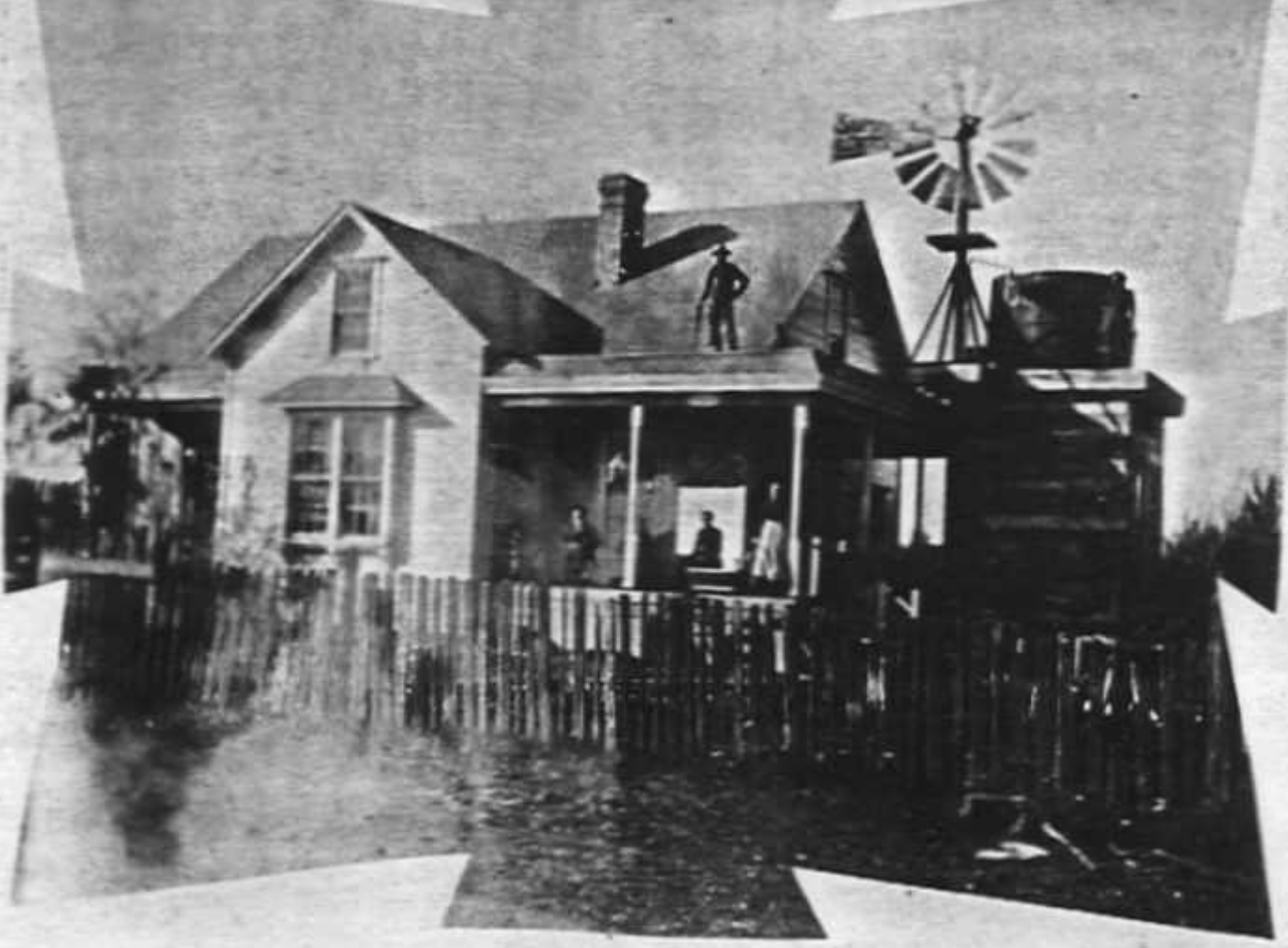
The Davis house in roughly 1890.
Levi built his house on the northwest corner of what became Covey and Davis roads and set up a small farming operation, along with an unusual business: carp ponds. He and neighbor John Reeves Hassell Oliver established large ponds full of the fish for people to purchase and eat.
In a July 1878 letter to the Santa Rosa Press Democrat, he wrote that Oilver’s carp were suffering. They drained the main pond and found “four ‘water dogs’ (salamanders) and one mud turtle, all of which I think have been living on his young fish,” Davis wrote. The carps’ breeding rates had declined dramatically, and two fish had their tails bitten off. “The necessity of a close watch over our fish ponds is thus apparent. — There is nothing wrong with mine.”
Lydia and Thomas
Lydia was very young when her family moved to Forestville, and it was likely the only home she could remember. I couldn’t find much information about her early life. Her family doesn’t appear in the 1880 census, and most of the 1890 census was lost in a fire in 1921.
But in 1889, when she was 24, she married Thomas Linton, who was born in September 1861 outside of Bloomington, Indiana, and arrived in California with his family around 1870. They were living in Vallejo when Thomas’ dad, Sanderson Linton, died in 1871. A few years after Thomas and Lydia married, they bought 15 acres of land in Forestville from George Nathaniel Schaumberg. It was part of a larger parcel that had changed hands a number of times since the 1860s, according to the earliest surviving maps.
In 1886, the block of land between today’s Covey and Travis Roads, and between Highway 116 and roughly Anderson Road, was owned by a man named Whitney. By 1867, a man named Williams’ name was stamped on the same region. Before 1884, someone named D.T. Callahan acquired it, and they sold it to Schaumberg that year. In 1895, Thomas bought the 15 acres from George, but also sold George about 3.5 acres in a land swap, according to real-estate listings in the Petaluma Daily Morning Courier.
This may seem tedious, but it was all part of my effort to figure out who, ultimately, built the house my family lived in in the 1980s and 1990s. By working both forward through time, starting with Cooper and Forrester and Covey (I may get to the Covey family in another post) and backward from my family to Malcolm Melville and Minnie Lehn Winkler, I eventually worked out the most likely answer: The Lehns.
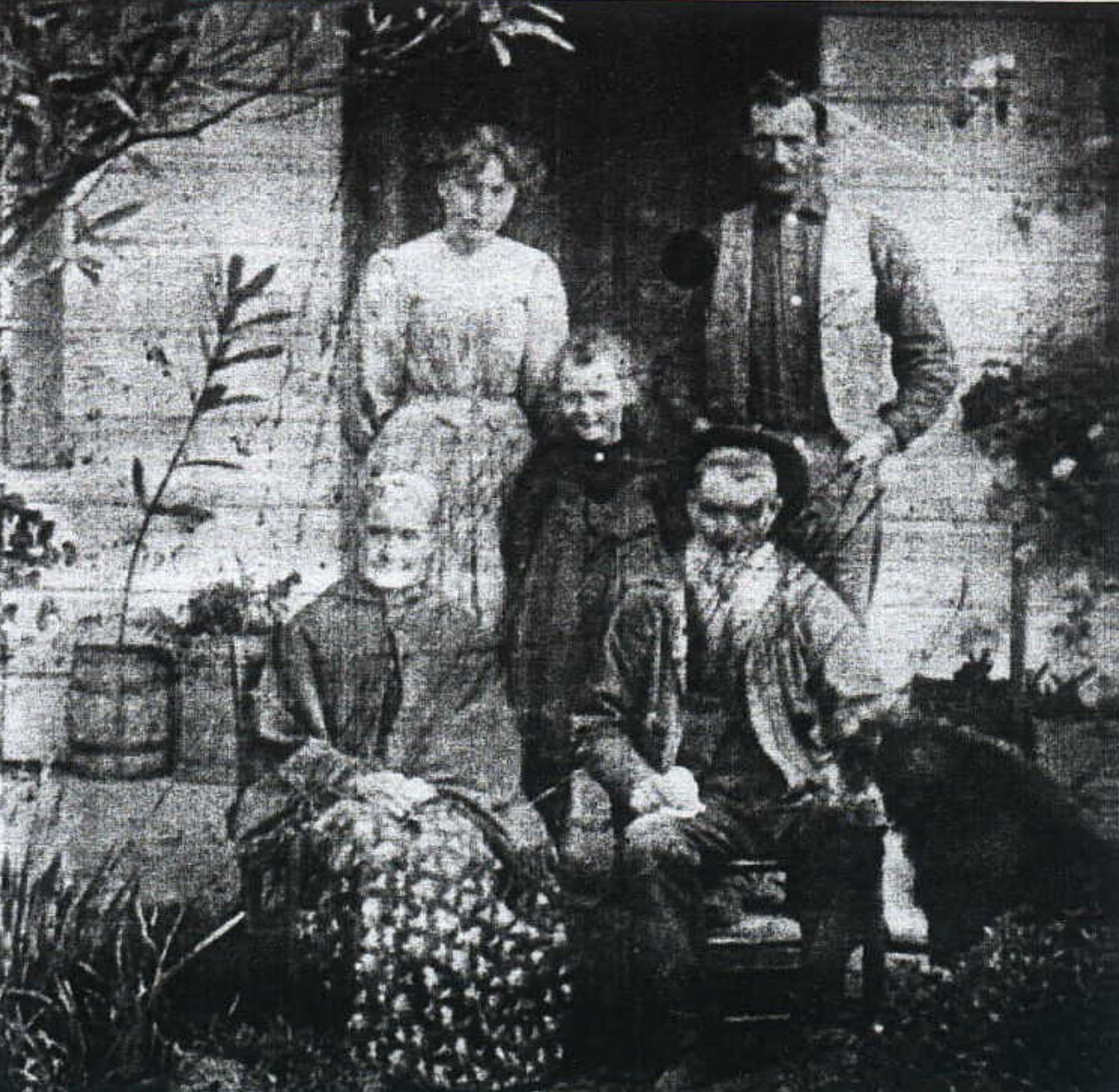
Back row: Lydia Davis and Thomas Linton with their daughter, Maude Grace. Front row: Rebecca Lakey and Levi Davis. Mid-1890s.
But just up the street from the Lehns, the Davis-Linton household was busy. Lydia and Thomas adopted a baby girl, whom they named Maude Grace, who was born in San Francisco in 1891. I can’t help but wonder if she was born to one of the women or girls in the San Francisco Magdalen Asylum. It’s a distinct possibility, but there’s probably no way to find out.

In 1901 and 1902, Thomas sold off sections of his land to the Santa Rosa Bank, William Lehn and Mary A. Jewett, and in August 1902, the Press Democrat reported that Thomas was tearing down the old Davis homestead and building a “new mordern (sic) residence” in its place.
A year and a half later, in March 1905, Levi Davis died at home, of cancer. “Man Who Imported Carp Passes Away,” the headline read. He was buried in Forestville’s Forestview Cemetery, along with many of the town’s early settlers.
Maude Grace
Maude was only 13 at the time of her adoptive grandfather’s death, but within two years she was married to Stuart Faudre, the youngest son of a famous local chairmaking family (which briefly operated where the Lehn winery later set up). Maude and Stuart ran off to Portland, Oregon, and eloped on July 12, 1907, when he was 33 and Maude was 15.
Stuart had already been married once, to a woman named Agnes or possibly Nettie, but they’d divorced by the time he married Maude. And it sounds like Stuart was bad news all around: The Petaluma Argus Courier reported in early July, 1907, that Grace (Maude) was missing and that Stuart had “enticed” her from home. “Last Tuesday evening she went to her room as usual, as if preparing to retire for the night. The following morning she had disappeared, and her room had not been occupied for the night.”
If the marriage wasn’t rocky from the beginning, it soon became so. According to the Press Democrat:
“Then from the lips of other Forestville people it was also learned that Faudre had declared on more than one occasion that he would … shoot his wife and then kill himself. Faudre had lived in the Forestville section since boyhood and his marriage to the young woman … occurred when she was about sixteen years of age. It was an elopement, and had a tinge of romance connected with it. … It is claimed that the marriage was celebrated before Faudre had been divorced from his previous wife for a year. She was a pretty girl and as time passed by Faudre is said to have become insanely jealous of her. She left him on a number of occasions, and he went after her and induced her to come back home.”
In the summer of 1907, Maude began seeking a divorce or restraining order (or both). She traveled north to Ukiah to stay with friends, but Stuart caught up with her on Tuesday, September 14. Before locating her, Stuart purchased a revolver. They were seen walking down Perkins Street together that night when a number of people heard him threaten her.
She said, “I don’t care if you do shoot me.” A few moments later, a struggle began, and he knocked her into the street, firing a shot at her as she fell. “She pleaded with him not to kill her and started across the street. He shot again and she fell and he ran up and shot again as she lay on the ground begging for her life. Several bystanders ran towards them and Faudre ran across a vacant lot and disappeared in the darkness.”
Bystanders helped Maude get medical care while Faudre ran to an apple orchard about a half-mile away, where he knotted a rope into a noose and fastened it around his neck before shooting himself in the head, ending his life. His family brought his body back to Forestville and buried him in Forestview Cemetery.
Although the newspaper initially reported that Maude’s condition was such as to give no hope for recovery,” she did ultimately survive the shooting.
Her attending doctor, named Whitlock, told the Press Democrat that:
“she was shot twice in the back on each side of the spine. One bullet grazed the spine. Neither bullet was located as the result of probing and the use of the X-Ray on Wednesday. Dr. Whitlock stated that both bullets would undoubtedly have gone clear through Mrs. Faudre’s body but the steels in her corset prevented."
Perhaps not surprisingly, Maude Grace mostly disappeared from the public record after the shooting. Even though her abuser was dead, her name had been splashed across newspapers around the region, giving her a kind of notoriety that was undoubtedly hard to live with. She remained in Ukiah for some time after the shooting.
Maude’s mother, Lydia, died at home on January 9, 1915, a few months after a reported surgery. She was buried in Forestview Cemetery. Thomas got remarried five years later to a woman named Lenora Horr. They moved to Santa Rosa sometime in the 1920s, where he worked as a poultryman. Lenora died in 1944 and is buried in Santa Rosa Odd Fellows Cemetery.
In November 1942, Maude took out a marriage license with a carpenter named R. George McAlister in Tacoma, Washington, but there’s no definitive record showing whether they ever married. On the application, Maude wrote her name as “Margerate” and said she’d been married once before, but was divorced. She and George had been living at the same address in Tacoma for the past six months.
Her father, Thomas, died July 29, 1957, at age 95, and joined Forestville’s settlers in Forestview Cemetery. Maude had no siblings, and it appears she had no children. I haven’t been able to find any record of her death, when or where it may have happened. If she wanted a private life after the shooting, it appears she got it.