forestville

Forestville stories: The Coveys, plus some research notes by Beth Winegarner

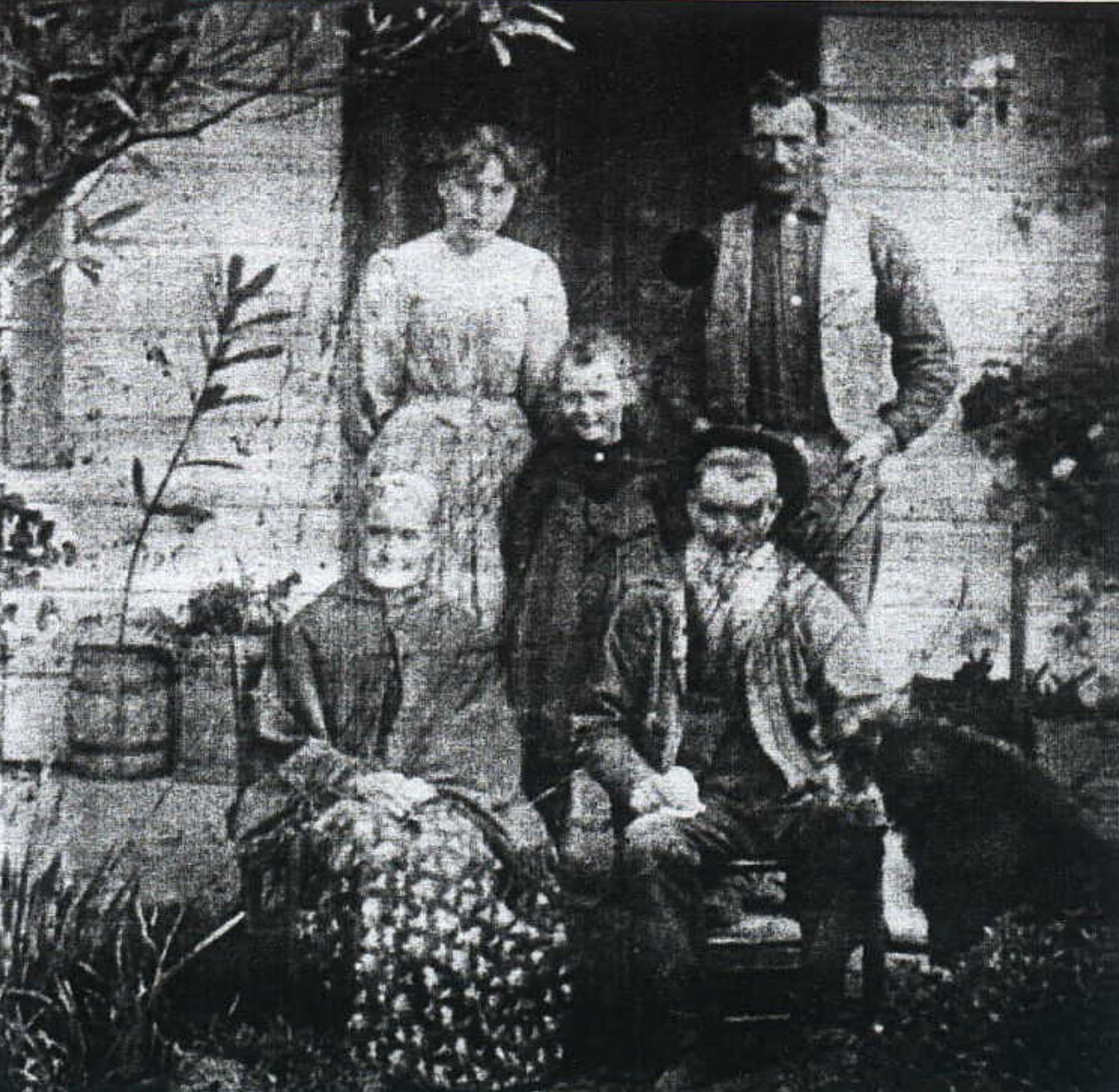
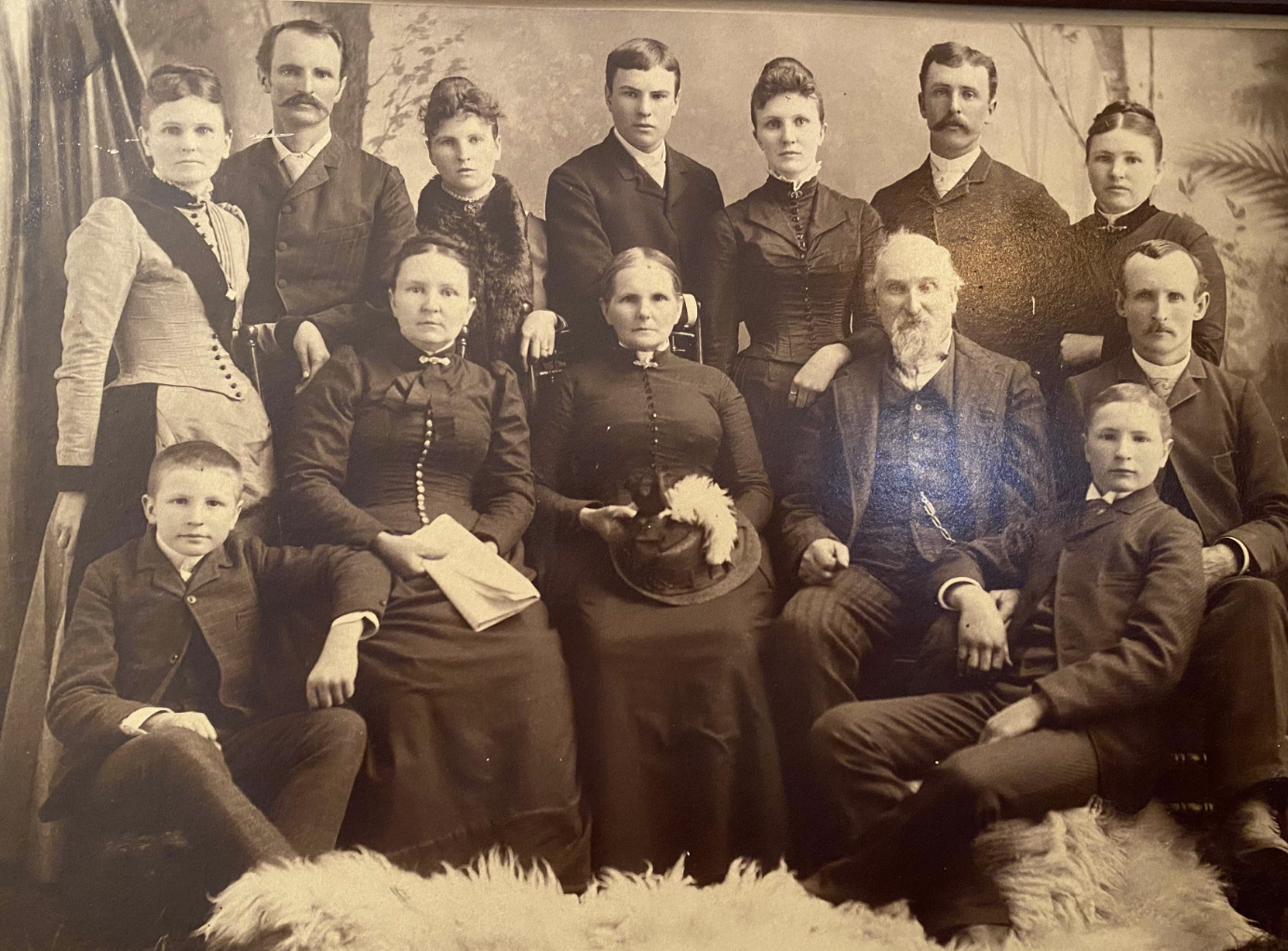
The Covey family. Back row, L-R: Ella, Daniel, unknown, William, unknown, Phillip, unknown. Middle row, L-R: unknown, Sarah, Uriah, George. Of the two boys on the sides, one is Harmon and the other is James. The unidentified women are likely Ann, Clara, Lizzie and Amanda. Photo courtesy Ancestry.com.

To wrap up this series, I wanted to write a little bit about the Covey family, since the street I grew up on (Covey Road) was named for them. I’ll also include some information at the end about where I got the information I’ve included in these posts, as it was a challenging process and I might be able to make it easier for future researchers. 

The Coveys

To start with, “Covey” can mean a couple of things. In earlier English, the word describes a small flock of birds; a covey of doves or quail, for example. As an Irish surname, it comes from Mac Cobhthaigh, meaning "son of the victorious one." I didn’t trace this family’s ancestry back far enough to figure out which one applies here. But, given that the Coveys had almost a dozen children, a “small flock of birds” seems an apt description. 

Uriah Covey was born in April 1832 in Ohio; his wife, Sarah Ann Purvis, was born August 20, 1838, in Memphis, Missouri. Uriah’s family moved to nearby Clark County, Missouri, when he was a young boy, and he and Sarah married in the state in either 1856 or 1859. 

It’s not clear what drew them to California, but Uriah was appointed to serve on a Sonoma County grand jury in September 1869, and the 1870 census shows them living in Healdsburg along with seven of their children: Ann, 14; George, 13; Clara, 9; Ella, 7; Daniel, 6; Phillip, 4; and Lizzie, who was an infant. 

Uriah seemingly always worked as a farmer, which isn’t surprising given Forestville’s agricultural focus. At least some part of that work involved raising chickens or other birds: “Mrs. Uriah Covey has lost a goodly number of poultry from some cause unknown,” The Healdsburg Enterprise reported briefly in 1889. 

By January of 1874, Uriah was buying up land in Forestville, according to real estate records from the Sonoma Democrat and other local papers. An 1898 map shows that he owned a large parcel just south of the Russian River and just west of Green Valley Creek, near the north end of Martinelli Road today. 
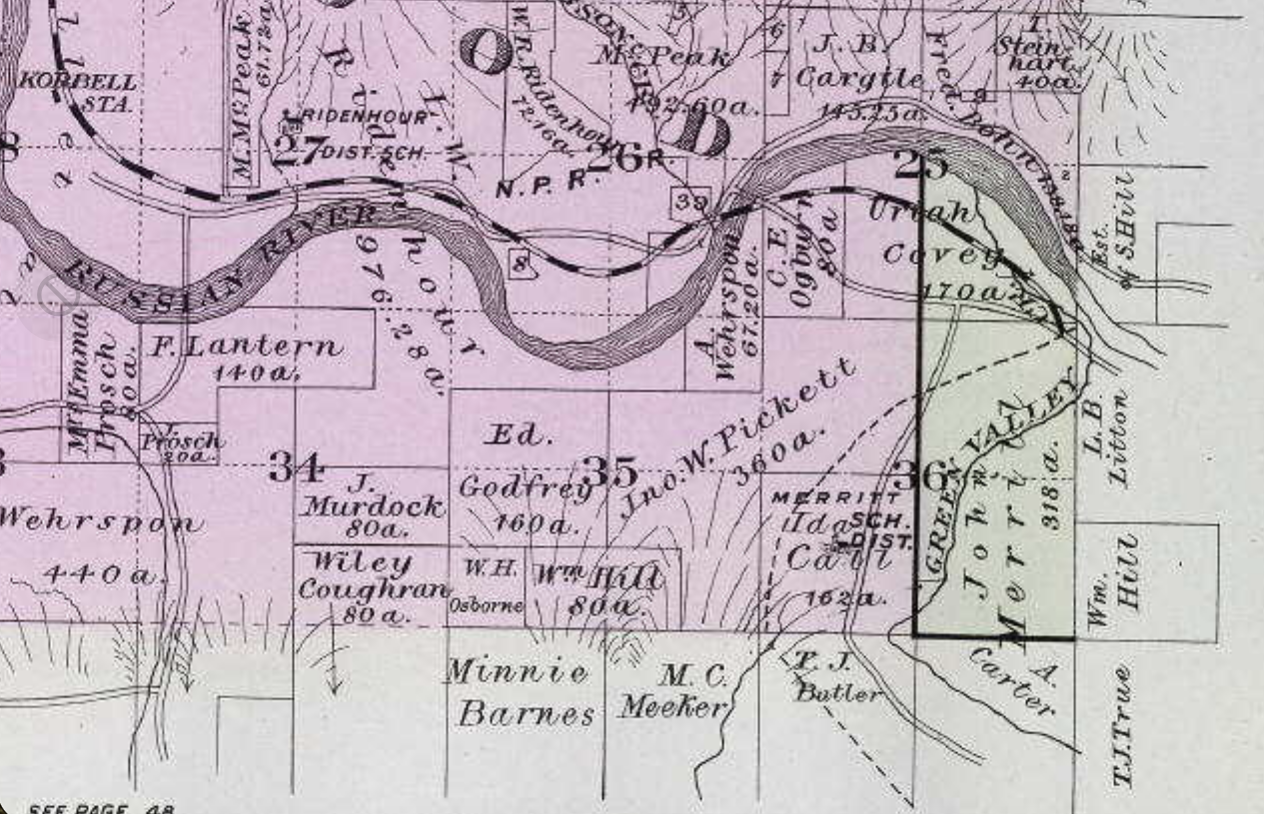
Detail from an 1898 map showing Uriah Covey’s land claim (upper right) and others along the Russian River, including the Ridenhours. Photo courtesy the David Rumsey map collection.

In the late 1870s, Uriah felled an old-growth redwood tree on his land and donated the wood for the construction of the Forestville Church of Christ, specifically its sanctuary and bell tower. Although the church is still standing, it was heavily damaged by a fire in 2019. 

Living near the Russian River and Green Valley Creek had its flood risks, then as now, particularly during the heavy winter rains. “If you wish to know about high waters in this locality, get Uriah Covey interested and he will tell you all about it,” the Healdsburg Tribune, Enterprise and Scimitar reported March 23, 1893. 

Growing up in Forestville in the 1870s when the population was small, many of the Covey children wound up marrying kids from other local families. Ella married Edward Lee Ward, who was born in Forestville in 1858, when it was barely a smudge on a map. 

Daniel, Amanda and William Covey married children of the Ross family, for whom Ross Road and Ross Station Road, just south of Forestville, are named. And James Covey, the baby of the family, born in Forestville in 1880, married Annie Ridenhour, whose family owned land between Forestville and Guerneville. 

In 1919, William and Hattie (Ross) Covey bought the house at the corner of Covey and Davis streets built by Thomas Linton on the Davis land in 1902. This may ultimately be why the road was named Covey, which didn’t get that name until sometime in the 1930s or 1940s; before that, it was called East Street or Foerster Street. 

Uriah and Sarah didn’t live to see their name immortalized; he died in 1909 at age 70 after a long, undisclosed illness, and was buried in Forestville’s Forestview Cemetery. He willed his property and their house to Sarah, who lived until 1921, when she died at age 82 and was buried alongside her husband. 

The last surviving children of Uriah and Sarah lived until 1957. Harmon, born in about 1877, died in May 1957, and his sister Amanda died about two months later. Both are also buried in Forestview. 
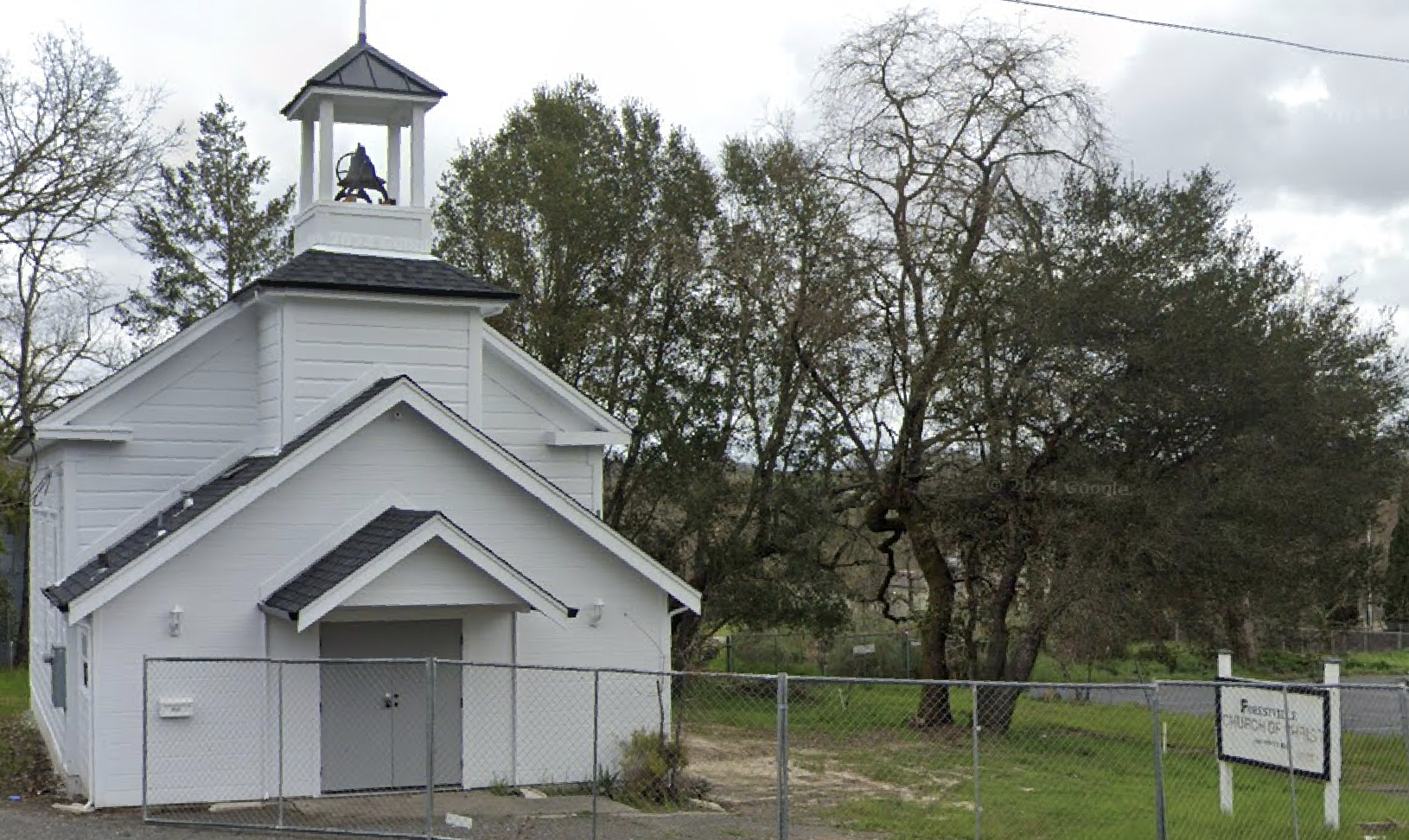
Forestville Church of Christ in March 2024, courtesy of Google Maps.

Research and process notes

I used a handful of main sources to trace the histories in this series: Historical maps, deed records, genealogy records, and historical newspapers. 

Historical maps for Forestville are difficult to come by, though there are a handful, particularly on the David Rumsey map collection website. Those maps helped me get some of the names of people who owned the land my family lived on, even if a) the roads weren’t all there and didn’t have their current names, b) the maps were very generalized, and c) most don’t show any structures. 

The Sonoma County Library’s historical archive does have two Sanborn fire insurance maps of Forestville, and Sanborn maps show structures, but they were limited to the town center and didn’t show the areas of town I was most interested in. 

Deed records from the mid-1960s to the present are available to research by the computers at the Sonoma County Recorder’s office, and earlier ones are digitized and available online at this link. This was painstaking, but the most important, work. I needed to know the names of potential owners and roughly when they might have purchased or sold the land, which both genealogical and newspaper records helped with.  

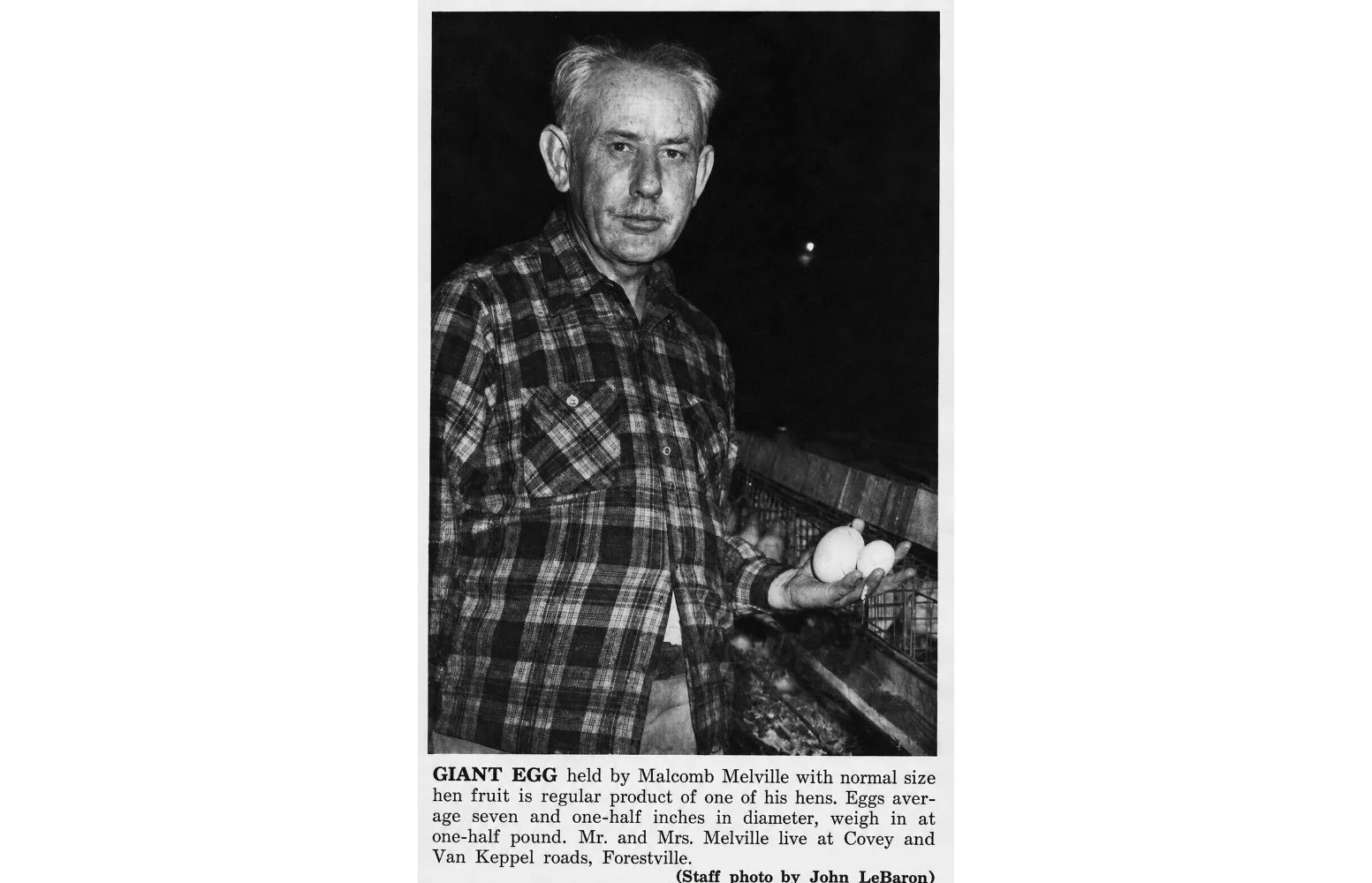
Once I had names, I could use genealogical records (I prefer Ancestry.com, despite its ownership), such as census, marriage and death records, to fill out the details of each person’s life. I also researched them in the invaluable California Digital Newspaper Collection. Luckily, early newspapers had a legal obligation to print real-estate transactions and often had room to report everyday events, such as Malcolm Melville’s larger-than-average egg or Levi Davis’ theories on carp management. And they also offered key details like the location of the Lehn family home, along with deaths/obituaries and family tragedies. These are the kinds of stories that make history more real and engaging. 

There’s also a book I found useful at certain points: “Images of America: Forestville” by Penny Hutten and the Forestville Historical Society,” published by Arcadia Press in 2008. Although it’s incomplete, this volume offers a look into the early days of Forestville, using many family photos in the historical society collection that aren’t available elsewhere. 

If you’ve made it this far, thanks for reading. I’ve enjoyed putting these stories together and going deeper into my understanding of the town my family called home for almost 20 years. 
Forestville stories: The Davises, the Lintons and the attempted murder-suicide by Beth Winegarner

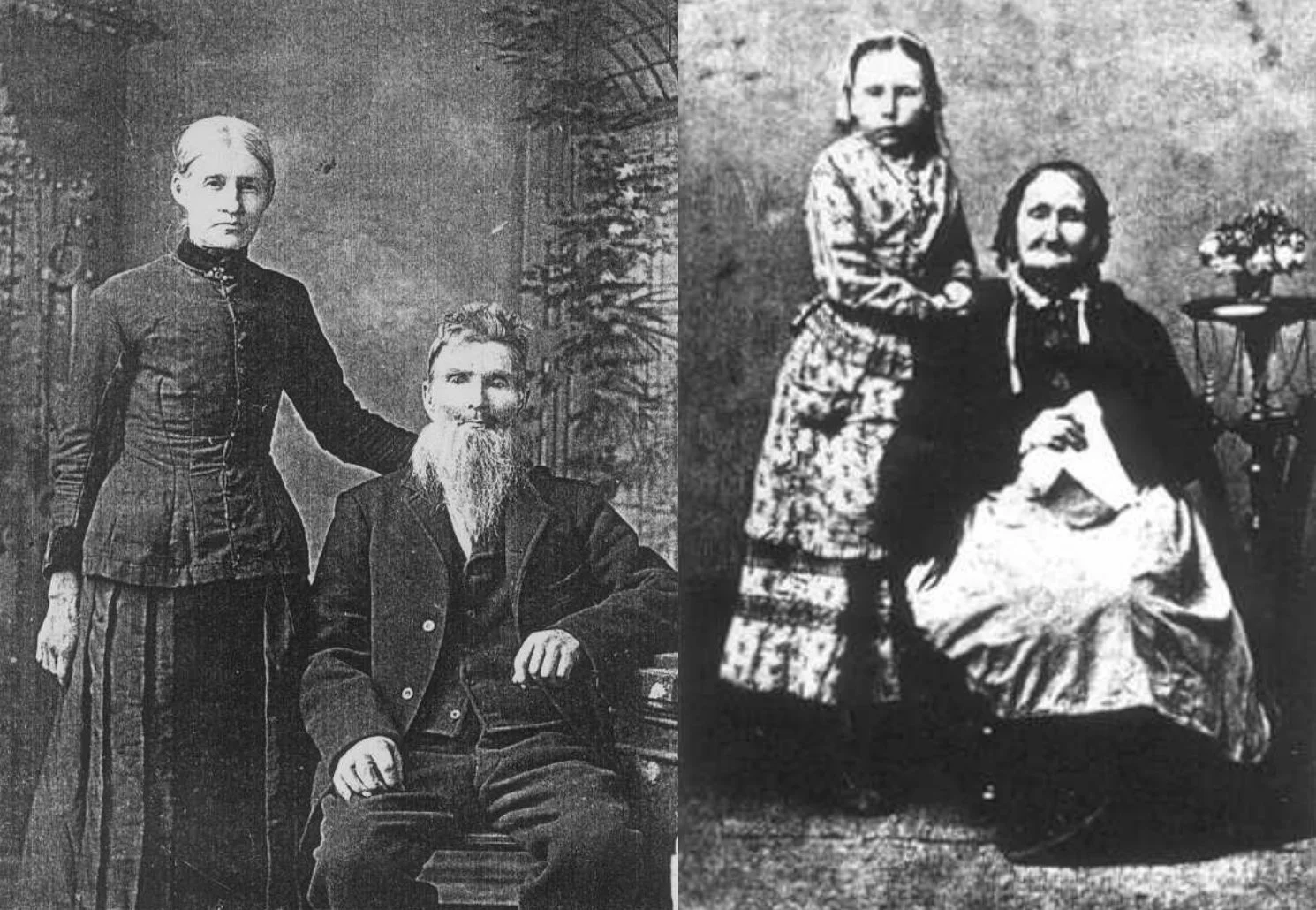
Left: Rebecca Lakey and Levi Davis. Right: Lydia Davis with her grandmother (and Levi’s mom), Rebecca Jack.

Content warning for discussion of domestic violence and suicide. 

Levi Davis wasn’t the first settler of Forestville, but he was one of the early ones. 

Born in Indiana in 1822, he married fellow Hoosier Rebecca Lakey in 1842, when she was 15 and he was 19. They lived in Missouri for several years before arriving in California and settling in Petaluma with their flock of eight children. Their youngest, Lydia, born in 1865, made nine. 

Levi was a farmer, which meant he could pick up and move just about anywhere there was good land. By 1870 the Davis clan was living in Forestville, across the street from where the El Molino/Laguna High School campus sits now. Davis Street is named for them. 

I should point out that the Southern Pomo were living happily on the land along the Russian River for thousands of years before settlers arrived, tending the river and the redwoods, including the areas that later became Forestville. This was not untouched, vacant, free land, and probably most of Forestville (like most of Western Sonoma County) was covered with redwoods before settlers came. 

One of the first settlers was Captain Juan Bautista Rogers (J.B.R.) Cooper (brother-in-law to General Mariano Vallejo), who set up shop northeast of town along Mark West Creek in 1834 and built a water-powered sawmill that hastened the destruction of the redwoods. In the 1860s, saloonkeeper Andrew Jackson Forrester purchased 100 acres of land, set up a new saloon and hotel, and named the town (Forrestville, at first) after himself. 

As other settlers arrived, early roads were laid out, and were usually named after whoever built a house there. Travis, Templeman, Anderson, Ross, Covey and Van Keppel roads (and many more) all got their names this way. 

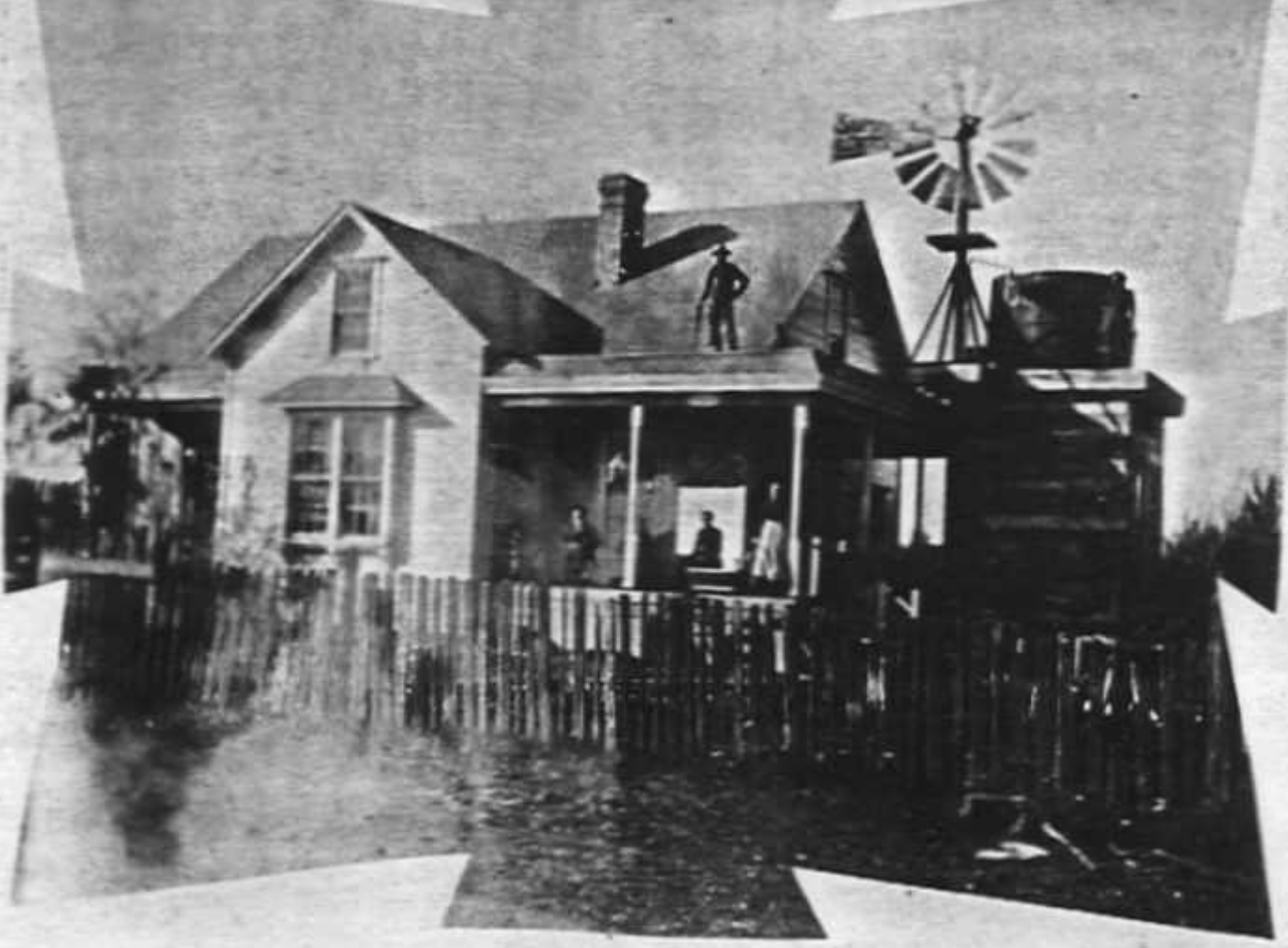
The Davis house in roughly 1890.

Levi built his house on the northwest corner of what became Covey and Davis roads and set up a small farming operation, along with an unusual business: carp ponds. He and neighbor John Reeves Hassell Oliver established large ponds full of the fish for people to purchase and eat. 

In a July 1878 letter to the Santa Rosa Press Democrat, he wrote that Oilver’s carp were suffering. They drained the main pond and found “four ‘water dogs’ (salamanders) and one mud turtle, all of which I think have been living on his young fish,” Davis wrote. The carps’ breeding rates had declined dramatically, and two fish had their tails bitten off. “The necessity of a close watch over our fish ponds is thus apparent. — There is nothing wrong with mine.” 

Lydia and Thomas

Lydia was very young when her family moved to Forestville, and it was likely the only home she could remember. I couldn’t find much information about her early life. Her family doesn’t appear in the 1880 census, and most of the 1890 census was lost in a fire in 1921. 

But in 1889, when she was 24, she married Thomas Linton, who was born in September 1861 outside of Bloomington, Indiana, and arrived in California with his family around 1870. They were living in Vallejo when Thomas’ dad, Sanderson Linton, died in 1871. A few years after Thomas and Lydia married, they bought 15 acres of land in Forestville from George Nathaniel Schaumberg. It was part of a larger parcel that had changed hands a number of times since the 1860s, according to the earliest surviving maps. 

In 1886, the block of land between today’s Covey and Travis Roads, and between Highway 116 and roughly Anderson Road, was owned by a man named Whitney. By 1867, a man named Williams’ name was stamped on the same region. Before 1884, someone named D.T. Callahan acquired it, and they sold it to Schaumberg that year. In 1895, Thomas bought the 15 acres from George, but also sold George about 3.5 acres in a land swap, according to real-estate listings in the Petaluma Daily Morning Courier. 

This may seem tedious, but it was all part of my effort to figure out who, ultimately, built the house my family lived in in the 1980s and 1990s. By working both forward through time, starting with Cooper and Forrester and Covey (I may get to the Covey family in another post) and backward from my family to Malcolm Melville and Minnie Lehn Winkler, I eventually worked out the most likely answer: The Lehns. 

Back row: Lydia Davis and Thomas Linton with their daughter, Maude Grace. Front row: Rebecca Lakey and Levi Davis. Mid-1890s.

But just up the street from the Lehns, the Davis-Linton household was busy. Lydia and Thomas adopted a baby girl, whom they named Maude Grace, who was born in San Francisco in 1891. I can’t help but wonder if she was born to one of the women or girls in the San Francisco Magdalen Asylum. It’s a distinct possibility, but there’s probably no way to find out. 

In 1901 and 1902, Thomas sold off sections of his land to the Santa Rosa Bank, William Lehn and Mary A. Jewett, and in August 1902, the Press Democrat reported that Thomas was tearing down the old Davis homestead and building a “new mordern (sic) residence” in its place. 

A year and a half later, in March 1905, Levi Davis died at home, of cancer. “Man Who Imported Carp Passes Away,” the headline read. He was buried in Forestville’s Forestview Cemetery, along with many of the town’s early settlers. 

Maude Grace

Maude was only 13 at the time of her adoptive grandfather’s death, but within two years she was married to Stuart Faudre, the youngest son of a famous local chairmaking family (which briefly operated where the Lehn winery later set up). Maude and Stuart ran off to Portland, Oregon, and eloped on July 12, 1907, when he was 33 and Maude was 15.  

Stuart had already been married once, to a woman named Agnes or possibly Nettie, but they’d divorced by the time he married Maude. And it sounds like Stuart was bad news all around: The Petaluma Argus Courier reported in early July, 1907, that Grace (Maude) was missing and that Stuart had “enticed” her from home. “Last Tuesday evening she went to her room as usual, as if preparing to retire for the night. The following morning she had disappeared, and her room had not been occupied for the night.”

If the marriage wasn’t rocky from the beginning, it soon became so. According to the Press Democrat:

“Then from the lips of other Forestville people it was also learned that Faudre had declared on more than one occasion that he would … shoot his wife and then kill himself. Faudre had lived in the Forestville section since boyhood and his marriage to the young woman … occurred when she was about sixteen years of age. It was an elopement, and had a tinge of romance connected with it. … It is claimed that the marriage was celebrated before Faudre had been divorced from his previous wife for a year. She was a pretty girl and as time passed by Faudre is said to have become insanely jealous of her. She left him on a number of occasions, and he went after her and induced her to come back home.”

In the summer of 1907, Maude began seeking a divorce or restraining order (or both). She traveled north to Ukiah to stay with friends, but Stuart caught up with her on Tuesday, September 14. Before locating her, Stuart purchased a revolver. They were seen walking down Perkins Street together that night when a number of people heard him threaten her. 

She said, “I don’t care if you do shoot me.” A few moments later, a struggle began, and he knocked her into the street, firing a shot at her as she fell. “She pleaded with him not to kill her and started across the street. He shot again and she fell and he ran up and shot again as she lay on the ground begging for her life. Several bystanders ran towards them and Faudre ran across a vacant lot and disappeared in the darkness.”

Bystanders helped Maude get medical care while Faudre ran to an apple orchard about a half-mile away, where he knotted a rope into a noose and fastened it around his neck before shooting himself in the head, ending his life. His family brought his body back to Forestville and buried him in Forestview Cemetery. 

Although the newspaper initially reported that Maude’s condition was such as to give no hope for recovery,” she did ultimately survive the shooting. 

Her attending doctor, named Whitlock, told the Press Democrat that:

“she was shot twice in the back on each side of the spine. One bullet grazed the spine. Neither bullet was located as the result of probing and the use of the X-Ray on Wednesday. Dr. Whitlock stated that both bullets would undoubtedly have gone clear through Mrs. Faudre’s body but the steels in her corset prevented."

Perhaps not surprisingly, Maude Grace mostly disappeared from the public record after the shooting. Even though her abuser was dead, her name had been splashed across newspapers around the region, giving her a kind of notoriety that was undoubtedly hard to live with. She remained in Ukiah for some time after the shooting. 

Maude’s mother, Lydia, died at home on January 9, 1915, a few months after a reported surgery. She was buried in Forestview Cemetery. Thomas got remarried five years later to a woman named Lenora Horr. They moved to Santa Rosa sometime in the 1920s, where he worked as a poultryman. Lenora died in 1944 and is buried in Santa Rosa Odd Fellows Cemetery. 

In November 1942, Maude took out a marriage license with a carpenter named R. George McAlister in Tacoma, Washington, but there’s no definitive record showing whether they ever married. On the application, Maude wrote her name as “Margerate” and said she’d been married once before, but was divorced. She and George had been living at the same address in Tacoma for the past six months. 

Her father, Thomas, died July 29, 1957, at age 95, and joined Forestville’s settlers in Forestview Cemetery. Maude had no siblings, and it appears she had no children. I haven’t been able to find any record of her death, when or where it may have happened. If she wanted a private life after the shooting, it appears she got it. 

More Forestville stories: Malcolm, Mary, and "Mama" Carr by Beth Winegarner

After my last post about Hichijiro Ito, Tomiye Mizutani and their family apple farm in Forestville, California, my dad and one of our former neighbors reminded me that our properties used to be part of a chicken farm before they were divided into smaller parcels in the 1960s for individual homeowners. 

That sparked another wave of research, and I discovered who lived in our house and ran that chicken ranch: Malcolm Melville (no idea if he’s related to Herman) and his wife, Mary Vargas. 

Malcolm and Mary purchased the land from Minnie Lehn Winkler in October 1944 (we’ll get to her in a future post!). At the time, the land was an apple ranch, according to a family history book titled “The Spilman Papers,” which makes sense, considering that much of the town was apple orchards and there was a fruit-drying operation down the street. They converted the land to a chicken farm in 1949, selling the eggs for “table use,” or home cooking, the history book says. 

On the other hand, the previous owners placed a help-wanted ad as early as 1919, saying they were looking for a husband and wife team to run a chicken farm, so it’s hard to say for sure when it converted from one to the other. 

Let’s go back to the beginning. 

Malcolm Leslie Melville was born in Chicago, Illinois, on January 18, 1897, to James Melville and Nannie Spilman. He grew up in nearby Wilmette, attended New Trier Township High School and, in 1916, went to Clark College in Worcester, Mass. In 1917 he enlisted in the U.S. Navy and served in WWI, becoming a radioman. After the war, he worked as an assistant radioman at Pearl Harbor, then took a job in 1925 with the Associated Oil Company. They brought him to their San Francisco office, where he served as an accountant for almost 20 years. 

His first marriage was to Irene Neff of Nebraska, in 1920; their son, Malcolm Jr., was born in 1921 or 1922. The marriage was brief, and Irene and their son stayed behind in Illinois when Malcolm moved out to California, where he married Katherine Lovejoy Morgan in 1927. But they split up, too, and Malcolm married Mary Vargas on September 26, 1939. 

They were married at A'ts'ina/Inscription Rock in Morro, New Mexico, under the pines in a “simple but impressive ceremony” followed by “a supper in the Custodian’s cabin.” 

Mary was born April 29, 1901, in Brooklyn, a former town in Alameda County, California, that was later annexed to Oakland. Her parents were Joseph Vargas and Rose Victorino, both of whom were born in the Azores. Malcolm was her first husband and, as he worked as an accountant in San Francisco, she worked as a typist. They lived with Mary’s dad in San Leandro. 

It’s not clear what prompted them to leave the big city and gamble on an apple farm in Forestville, but in 1944, Malcolm was 47 and Mary was 44; maybe they felt it was time to get out of the corporate world. As the chicken business spun up and WWII ended, they hired local Japanese-Americans and trained them to raise chickens, gather eggs and handle other aspects of the business. 

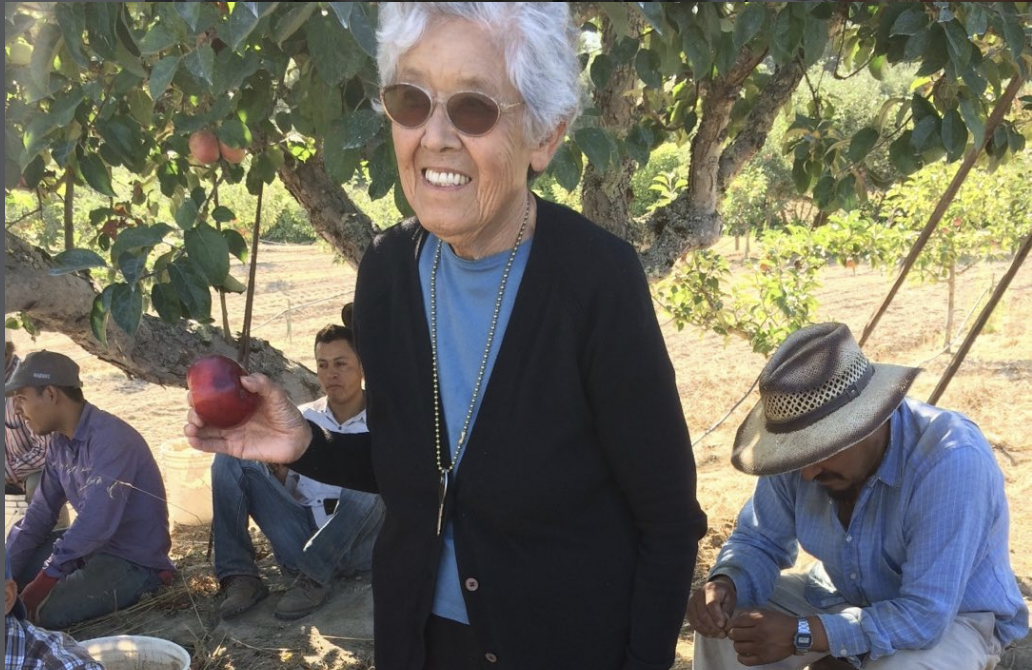
One of those workers was Michiko Kameshima, who later became known as Betty Carr; she later founded Forestville’s Carr’s Drive-In with her husband Henry and, later still, Mom’s Apple Pie. She recently died, on May 19, 2026, at the age of 95. You can read her obituary here. 

Betty (Michiko) Carr with a Gravenstein apple, courtesy of the Mom’s Apple Pie Instagram page.

In the early years at least, it seems like business was good. In 1947, a local newspaper reported, “Mr. and Mrs. Melville have been remodeling their home on Covey Road, which is now considered one of the attractive homes in Forestville.”

A few years later, in April 1952, they had a scare when Malcolm was burning brush in the yard and a cinder floated up to the roof, sparking a small fire. A newspaper reported, “Very little damage was done and all was covered by insurance. Mr. Melville had the fire under control by the time the firemen arrived, but commended the boys on their speedy answer to his call. He feels that much more damage would have been done if he had not discovered the blaze in its infancy.”

Malcolm and Mary’s work with Japanese Americans led the Japanese government to invite them to the country to travel around the islands and speak to farmers about the poultry business. They went twice, in 1956 and 1962, for a few months at a time. 

It appears business took a turn for the worse in the mid-1950s; records show that Malcom and Mary remortgaged their property in 1955, 1957, 1959 and 1961. They formally retired from the chicken business in 1960 and sold the land to Katherine Murdock in 1963, when Malcolm was 66 and Mary was 63. Murdock was the one to subdivide the land, leading to a number of new homes built around theirs/ours in the 1960s and ‘70s. 

The couple retired to Medford, Oregon, where Malcom died in 1972 at 75, and Mary died in 1990 at 89. They’re buried together in Siskiyou Memorial Park

When we moved into the house, in early 1980, there were few signs of the former chicken farm or even the apple farm before it, aside from a dilapidated shed and a couple of Gravenstein apple trees. One side of the shed became an occasional playhouse for my brother and I and his friends, and we used the other side as a chicken coop for a while, until raccoons came for most of our hens. 

At the bottom of the garden was a concrete retaining wall and patio that extended beyond the fence and to our neighbors’ yard, where a large round basin in the concrete used to be filled with water for the chickens to drink from. It may still be there. 

I’m fascinated by the idea of “land ancestors” — people who had a relationship with a place before we did. These folks are some of my land ancestors, and I love that they had a close and agricultural connection to the place where I grew up.

Next time, I’ll write about the lives of Minnie Lehn Winkler and her first husband, William Lehn, who ran a successful winery in Forestville in the years before Prohibition. 

The apple-growing Ito family of Forestville, California by Beth Winegarner

(This is NOT a bite-sized entry, apologies; it turned into something much bigger)

I’ve been researching my hometown, Forestville, for some writing I’m working on. I was looking through the California Newspaper Digital Collection (CDNC), because the Wikipedia article on the town mentions some kind of fire that took place in the early 20th Century and destroyed most of the early buildings. I didn’t definitively find any reports (though it could refer to this fire at the Lehn Winery in September of 1915 that resulted in a bunch of drunk hogs). 

But I did find something else: Information about a multigenerational Japanese family that ran an apple farm in Forestville from sometime in the 1910s until after World War II. I’d like to share what I’ve learned, because it’s a story I never learned growing up there and I really wish I had. 

Hichijiro Ito was born in Japan on May 10, 1875 (as I’m writing this, his birthday would have been yesterday). His mother’s name was Ecishi; I’m not sure what his father’s name was. His wife, Tomiye Mizutani, was also born in Japan, likely in 1881 or 1883. She most likely married Hichijiro in Japan and immigrated with him, though I was unable to find very much about her life. They had a son, Yoshinobu, who was born in Japan on October 12, 1905. 

The Ito family came to the U.S. and settled in Forestville sometime in the 1910s. They set up an apple farming operation on Covey Road near Davis Road, where El Molino High School was later built. It’s worth noting that the apples were Gravensteins, which were a popular Sonoma County crop, brought to the U.S. by the Russians who settled at Fort Ross in the early 19th Century). 

On November 7, 1923, a fire broke out on the Ito property, destroying two houses and damaging the Ito family’s apple-drying machine. The dryer had been used that day, but the boy who tended the kiln had made sure the fire was out before he left for the night. Neighbors said the fire started on the roof around 1 a.m., and a reporter suggested that a spark from the kiln became lodged in the vent and later ignited the roof. 

Most critically, one of Hichijiro and Tomiye’s sons, likely Yoshinobu, was in danger from the fire. He was asleep in their home, but an unidentified someone ran into the house and pulled him from his bed. 

The Oakland Tribune reported that the Ito dryer was located next door to the Sebastopol Apple Growers’ Union packing plant (another paper identifies it as the The Forestville Union Packing house). The fire could have spread to the packing house — and to the rest of the town —if not for “hundreds of people” who woke and came out to help fight the fire. Forestville, then and now, was an unincorporated part of Sonoma County and didn’t have its own (volunteer) fire department until 1938, so neighbors had to rely on each other when fires broke out. 

Aside from the apple dryer and two homes, the fire consumed 20 tons of green apples and eight and a half tons of dried apples. Newspapers reported that the fire caused about $5,000 in damage (almost $100,000 in today’s dollars), $3,800 of which was covered by insurance. 

The Santa Rosa Press Democrat reported that, after the fire, Hichijiro “is ready to rebuild, providing the residents do not object. The residents will no doubt object, as the drier was located near the heart of the town, which was in immediate danger, due to the inadequate fire fighting apparatus.”

I can’t help but wonder if that was the only reason neighbors might have objected. Although World War II was almost two decades away, anti-Japanese and anti-Asian sentiment was well entrenched across California.

Still, it appears the Itos rebuilt their operation. In July 1931, Hichijiro and his son Yoshinobu certified themselves as co-owners of a “retail green and dried fruit business under the name of H. Ito and Son” in Forestville. 

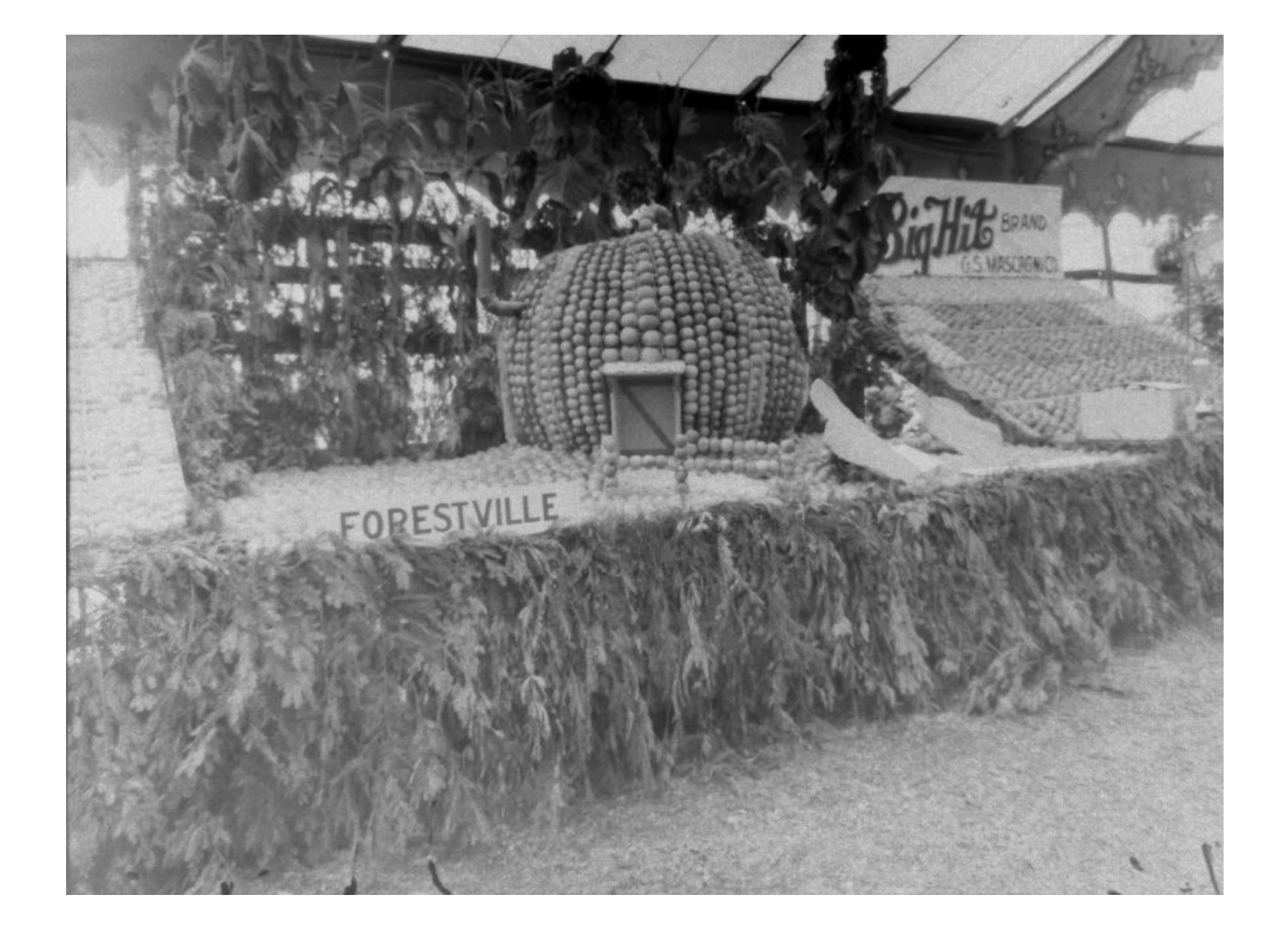
Circa 1930 Gravenstein Apple Show display of an huge apple, made of apples for the town of Forestville exhibit. Photo by William S. Borba.

Another member of the Ito family appears in the 1930 census, a boy named Kazuo, born December 8, 1922 and identified as Hichijiro’s grandson. Hichijiro and Tomiye had another son before Yoshinobu, but I have not been able to find much information on who he was. (He’s identified in this interview by the American name Frank, and in Kazuo’s obituary as Yoshimatsu.)

In mid-January 1932, Yoshinobu Ito, then 26, and Tsugive Hatanaka, 18, of Oakland, took out a marriage license. They were formally married on January 21, 1932, likely on the Ito property in Forestville.

The Santa Rosa Press Democrat reported

Elaborate Japanese Wedding Is Performed at Forestville

FORESTVILLE, Jan. 21. An elaborate Japanese wedding took place here Sunday, uniting Tsugiye Hatanaka and Johnnie Y. Ito in marriage. All members of the bridal party and the minister were Japanese. The Rev. T. Friljii of the Sebastopol Japanese Methodist church performed the ceremony. Following the wedding, 200 guests were entertained at a bridal dinner with K. Akutagawa as master of ceremonies. Talks were given in both American and Japanese. The bride is a daughter of Mr. and Mrs. Hatanaka of Oakland. She was dressed in a white satin gown with a beautiful lace veil. The veil was held in place by a cap of lace and pearls. The bride was attended by the following bridesmaids and flower girls: Miss Jlatanaka, Miss Xishioka, Miss Kobuka, Miss Takemoto. Miss Ikeda, Miss Akiya and one of her younger sisters. Ro was supported by cousin, Tommy Ito. The groom is the youngest son of Mr. and Mrs. H. Ito and attended schools here. He is associated with his father in fruit growing and packing. The couple left Sunday night for a honeymoon trip to Los Angeles and other parts of southern California.

Yoshinobu and Tsugiye had two sons, Hiromu, born in May 1934, and Akira, born in May 1939. 

On July 2, 1940, the Oakland Tribune ran an article about a rivalry between apple growers from Sonoma County: 

Two produce firms this morning reported the receipt of Gravenstein apples, the first to be received in Oakland for the current season. Jack Oliver, of W. A. Rouse & Company, received a shipment from H. Ito, rancher of Forestville, Sonoma County. Ito usually "beats" his competitors. This year, however, V. Sangiacomo, of Sonoma, shipped to Angeli Brothers on the same day They were put on display by Joe Cellini of that firm. The fruit was quoted for from $1.85 to $2 per lug.

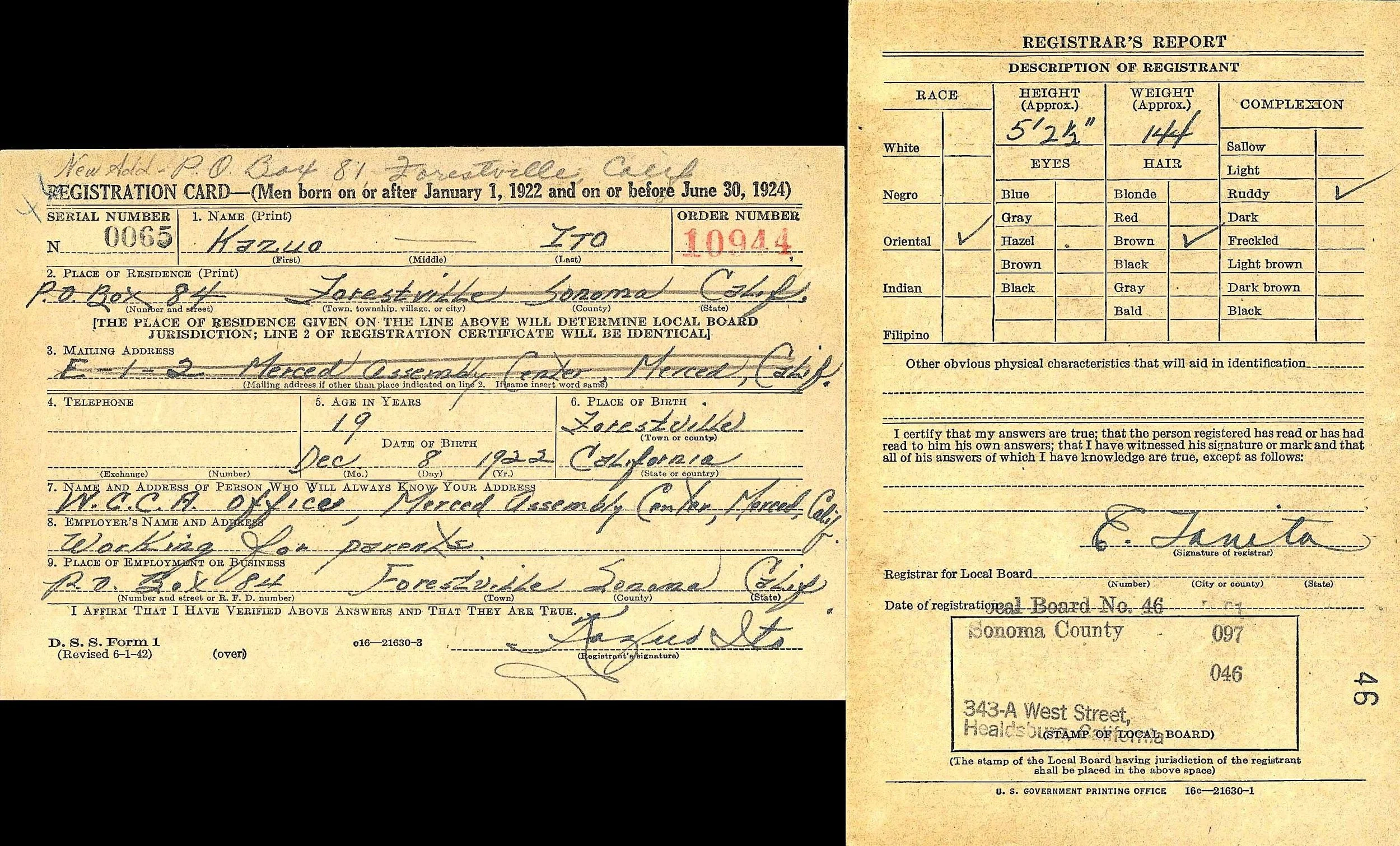
Kazuo graduated from Analy High School in Sebastopol in 1940. After World War II began, at 19 and a U.S. Citizen, he registered for the U.S. Draft. His registration card lists him as five feet two and a half inches tall and 144 pounds, with brown hair and a ruddy complexion. He reported that he was “working for parents” and gave an address of P.O. Box 84 in Forestville. He also listed the Merced Assembly Center in Merced, California as an address, but crossed it out. 

The Merced Assembly Center was a temporary internment camp for Japanese Americans that operated for about five months between May and September of 1942 before prisoners were sent elsewhere. The U.S. kept Kazuo along with the rest of his family in Merced before sending them on to “Camp Amache” or the Granada War Relocation Center in Granada, Colorado, hundreds of miles from Forestville. 

They were registered in Granada on September 9, 1942. Hichijiro was 67 and Tomiye was around 60. The little boys, Hiromu and Akira, were 8 and 3. 

A friend of the family, Tom Perry, said in a 2003 interview that his parents took care of the Ito ranch while the family was imprisoned. He grew up playing with one of the Ito kids, whom he identifies as Keith (probably Hiromu). Perry said: 

Anyway, I know that Johnny (Yoshinobu) ran the dryer and he and Sue (Tsugiye) lived on our ranch there for a while before the war and before they bought a place on Hurlbut Avenue (in Sebastopol). Their sons were Steve and Keith, who was just a few months younger than me, and Keith was my first playmate. I have a number of pictures where we were toddlers together. And Keith and I went all through school together, through grammar school, high school. I was four years old when the war began, so I don’t remember much of what was going on. I remember my mom talking about them being back in the camps. I knew about camping, that sounded like fun. So that was how much I knew back in those days when the war started and the internment situation took place. 

While most of the Ito family were in Colorado, Hichijiro was accused of criminal espionage and shuffled around the country.

Tom Perry recalled: 

So Grandpa disappeared. [He] was accused of being a spy. He was sent first to Louisiana, then to New Mexico. He was accused of having maps in his place. Maps! If you have maps in your house you’re obviously suspicious, and he was accused of having $40,000 sewn into his clothing. $40,000 in those days would be about a million today. Not too likely, but this was the story. Supposedly he was convicted. So he wasn’t able to join his family until 1944, when he joined the rest of the family in Amache. I’m not sure whether he was acquitted later. It was rumored this was the case, but for sure he was put away for some time for “committing the crime.”

Perry’s mom, Lea Perry, wrote letters back and forth with Kazuo while he was in Merced and later Granada, discussing and coordinating operations of the Ito ranch in Forestville from 1942 until they were released in 1945. Incredibly, all of these letters were donated and digitized, and are available to read online in Sonoma State University’s digital collection. The Itos apparently sent the Perrys small amounts of money in thanks for running the ranch in their absence, and at least once, Lea told them she could not accept the money, knowing they were receiving so little in the camp. 

Lea also sent them gifts. Tomiye in particular loved persimmons, and Lea would send some on occasion. Tom Perry recalls: 

In fact, I can still remember as a five year old, the persimmon tree. I didn’t know what they were so I bit into one one day, and (laughs) thought, this is not to eat. When they got ripe, Grandma Ito liked persimmons, so my mom would send them to her. Also apples and dried fruit. Of course, it was really appreciated. I remember one of the letters told about when they were in Merced, she shipped down a box of apples and Kaz said, “I grew up with these apples. We would even throw them from time to time, as kids, like baseballs.” He said, “I never realized how good they are and what a treat it was to have them.”

The Itos were released from detention on September 26, 1945 and most, if not all, returned to Forestville and Sebastopol.

It helped that the Perry family had been taking good care of their ranch and their houses in both towns. Tom also thought that the Itos had perhaps faced less racism in Sonoma County than Japanese people had in other parts of the country, possibly because they had been established in the area so long before the war. “I think that there were enough people here who knew the Japanese and what good people they were,” Perry said. “Also, people like my folks who took care of ranches, made people feel that their home was here, and that their places were here and they were cared for.”

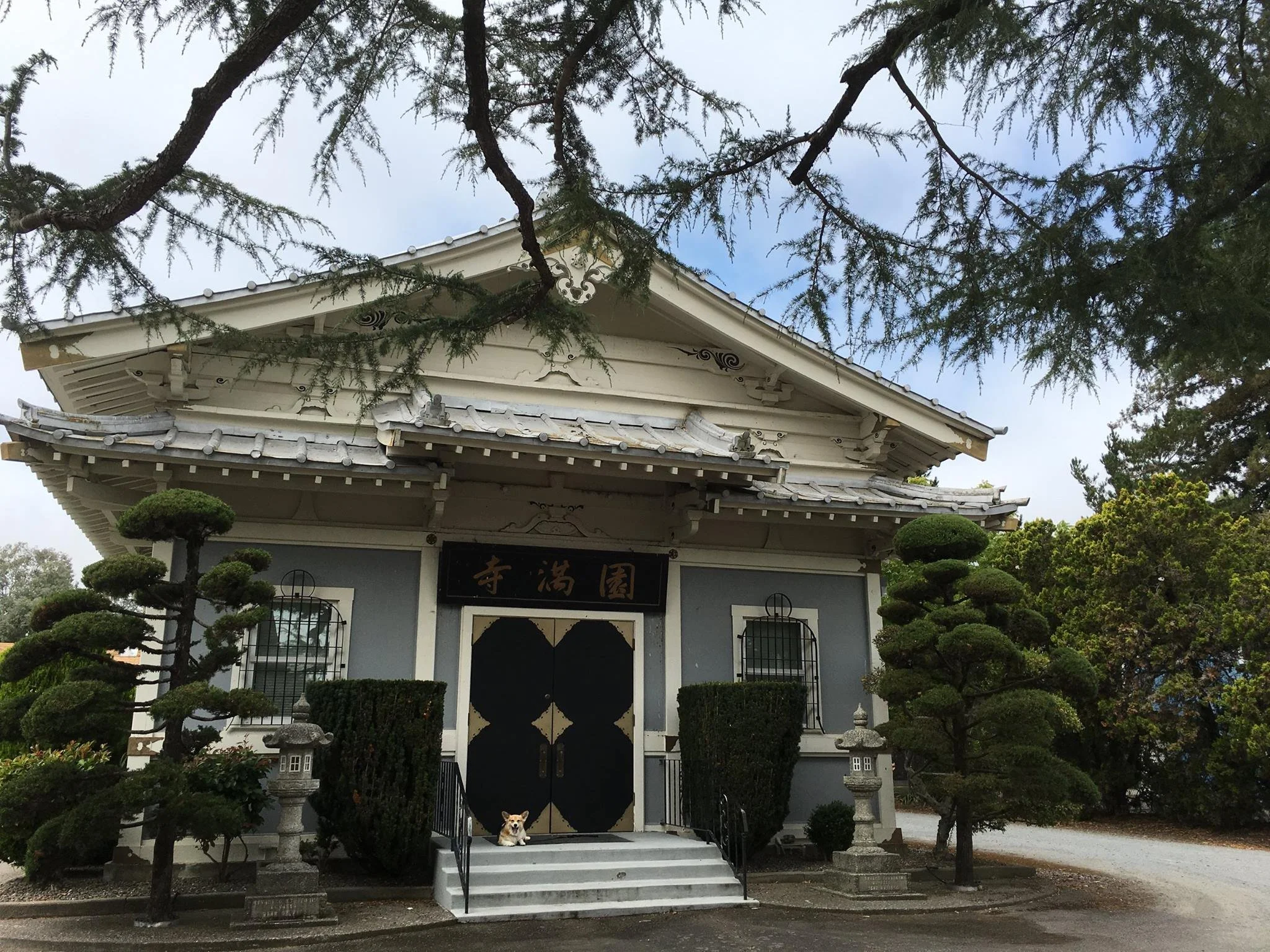
Enmanji Buddhist Temple in Sebastopol, California.

Perry also mentioned that Hichijiro was involved in establishing the Enmanji Buddhist Temple in Sebastopol. Before the temple, a Buddhist Sunday school and Japanese language school launched in 1926, and in 1928 a minister from the Buddhist Mission of North America visited the area to begin missionary work. Japanese Sonoma County residents met in 1932 to talk about establishing their own temple, and purchased a house in Sebastopol, opening the first temple space in 1933. Its first minister was Rev. Shodo Goto.

The current building, however, has an even more amazing story: It was constructed by workers with the Manchurian Railroad Company and used as part of their exhibit hall at the Chicago World's Fair in 1933. After the fair, the company donated the building to the Buddhist Mission of North America, which in turn offered it to the Sonoma County folks. It was dismantled in Chicago and transported by rail to Sebastopol, where it was rebuilt — without the use of nails — in early 1934. 

Difficult news continued to follow the Ito family after the war. On June 30, 1949, a newspaper reported that “The friends of Kazuo Ito will be sorry to hear that he is confined in Oak Knoll hospital. He would appreciate hearing from different ones.” And in early November 1950, Hichijiro was released from Palm Drive Hospital in Sebastopol after undergoing two weeks of treatment for burns. 

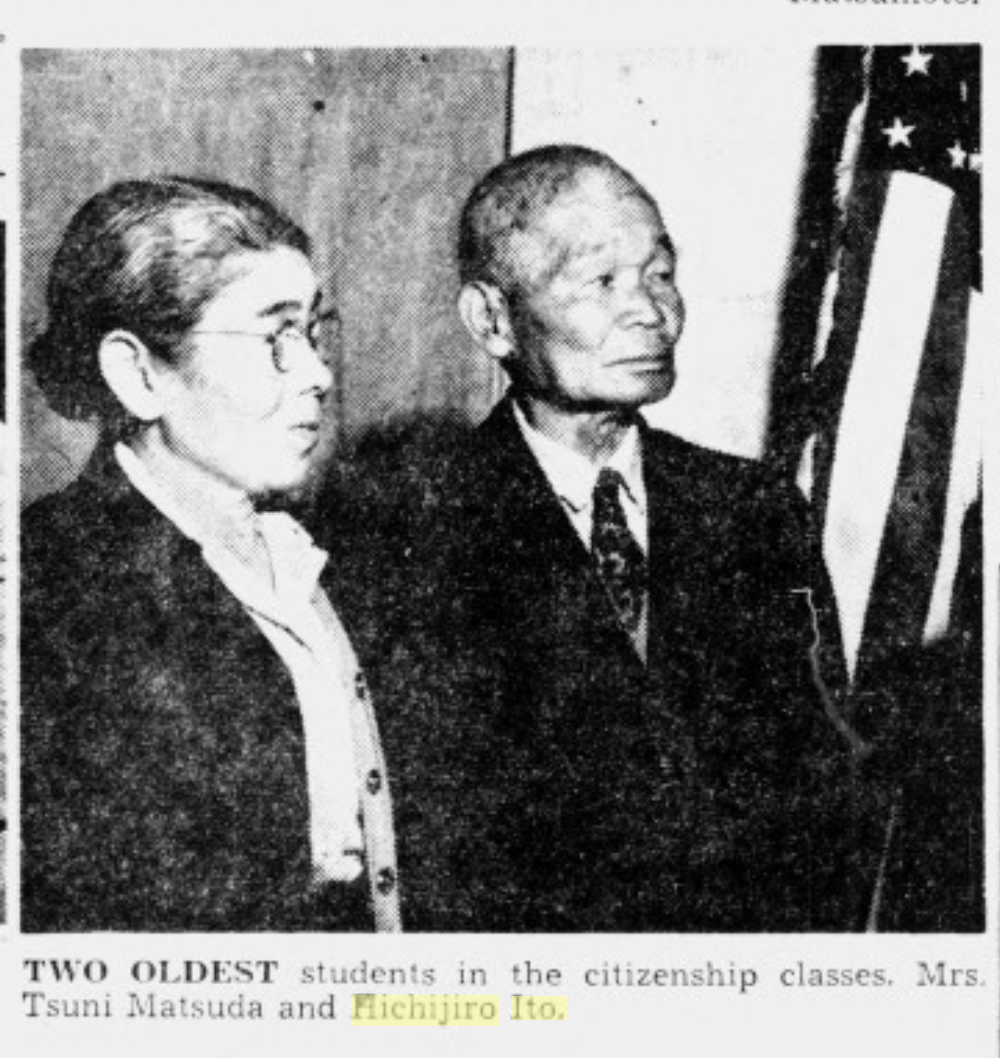
More cheerfully, Hichijiro was featured in a 1953 Press Democrat article about a group of 76 local Japanese Americans finishing a citizenship class so they could become naturalized in the U.S. Such classes were made possible by the 1952 McCarran-Walter Act, which made it easier for Asians to immigrate to the U.S., and for those already in the U.S. to become citizens. Among his classmates, Hichijiro was the oldest, at 78. 

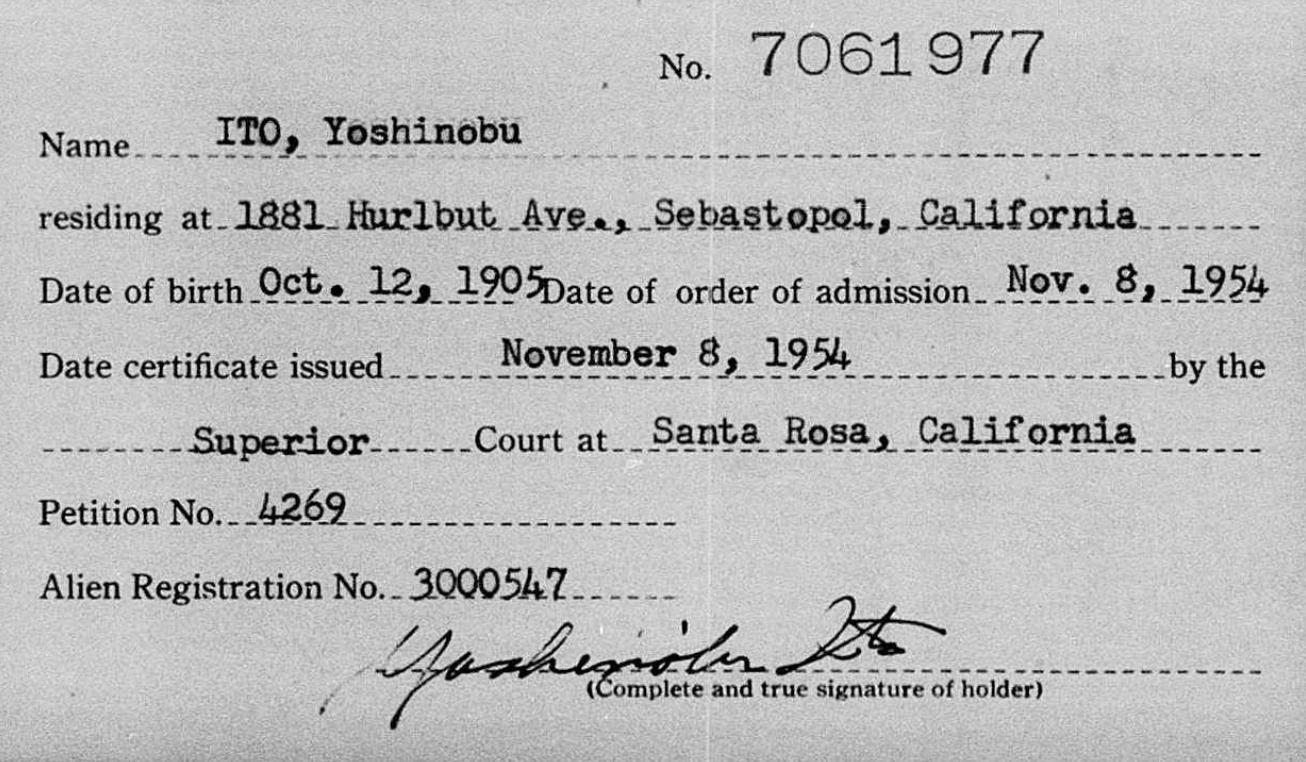
Yoshinobu became a citizen in November 1954.

Kazuo was the first of the Forestville Ito clan to die, on May 5, 1955, at age 32. The Enmanji Temple hosted his wake, and his ashes were committed at Chapel of the Chimes in Santa Rosa, according to the Press Democrat. 

Hichijiro followed a few years later, in February 1958, at the age of 83. Like Kazuo, his wake services took place at Enmanji and his ashes were committed at Chapel of the Chimes. The Press Democrat reported: “Mr. Ito died Wednesday in a Santa Rosa hospital. He lived in Forestville 45 years after coming from Japan. He was an apple rancher on Covey Rd. He is survived by his wife, Tomie Ito, Forestville; sons, Yoshinatsu Ito, Sacramento, Yoshinobu Ito and Tom Ito, both of Sebastopol, and eight grandchildren.”

Yoshinobu died February 10, 1994 at the age of 88. Enmanji hosted his wake, and his ashes were inurned at Pleasant Hill Cemetery (now Pleasant Hills Memorial Park) in Sebastopol. The Press Democrat reported: “A native of Japan, he came to Forestville in 1920 to join his father in running an apple dryer and apple orchard. He was a member of the Enmanji Buddhist Church and the Japanese American Citizens League. Survivors include his wife, Tsugiye Ho of Sebastopol; his children, Steven Ito of Sacramento, Keith Ito of Concord, Philip Ito of Santa Rosa, Mildred Milne, Ft. Bragg and Katharine Legro of Calistoga; seven grandchildren and one great granddaughter.” 

Tsugiye died in May 2022, and is also inurned at Pleasant Hill. 

I regret that there are so many gaps in this account — I wasn’t able to find much information on Yoshinatsu or Tom Ito, or follow the lives of Hiromu or Akira, or locate details on the women of these families, especially Tomiye and Tsugiye. There is a much deeper story here to be told of the Ito family in Sonoma County, and Japanese American apple growers and farmers more generally. But I hope this will make it easier for family members and researchers in the future.